By
Sanjana Chavali
June 4, 2026
•
8
min read

Training retail staff in India requires infrastructure that most traditional learning platforms don't have.
Most learning management systems were built for office environments: employees with laptops, reliable wifi, desktop notifications, email access. Indian retail has none of these.
A store associate works an 8-hour shift on a budget Android phone (₹5,000-20,000 range). They don't check email. They're not sitting at a desk. Data connectivity fluctuates depending on location and time of day.
Traditional LMS platforms assume consistent, desktop-first access. Indian retail needs something different.
A traditional LMS says: "Training is available online. Access it on your device during breaks."
The reality in Indian retail stores:
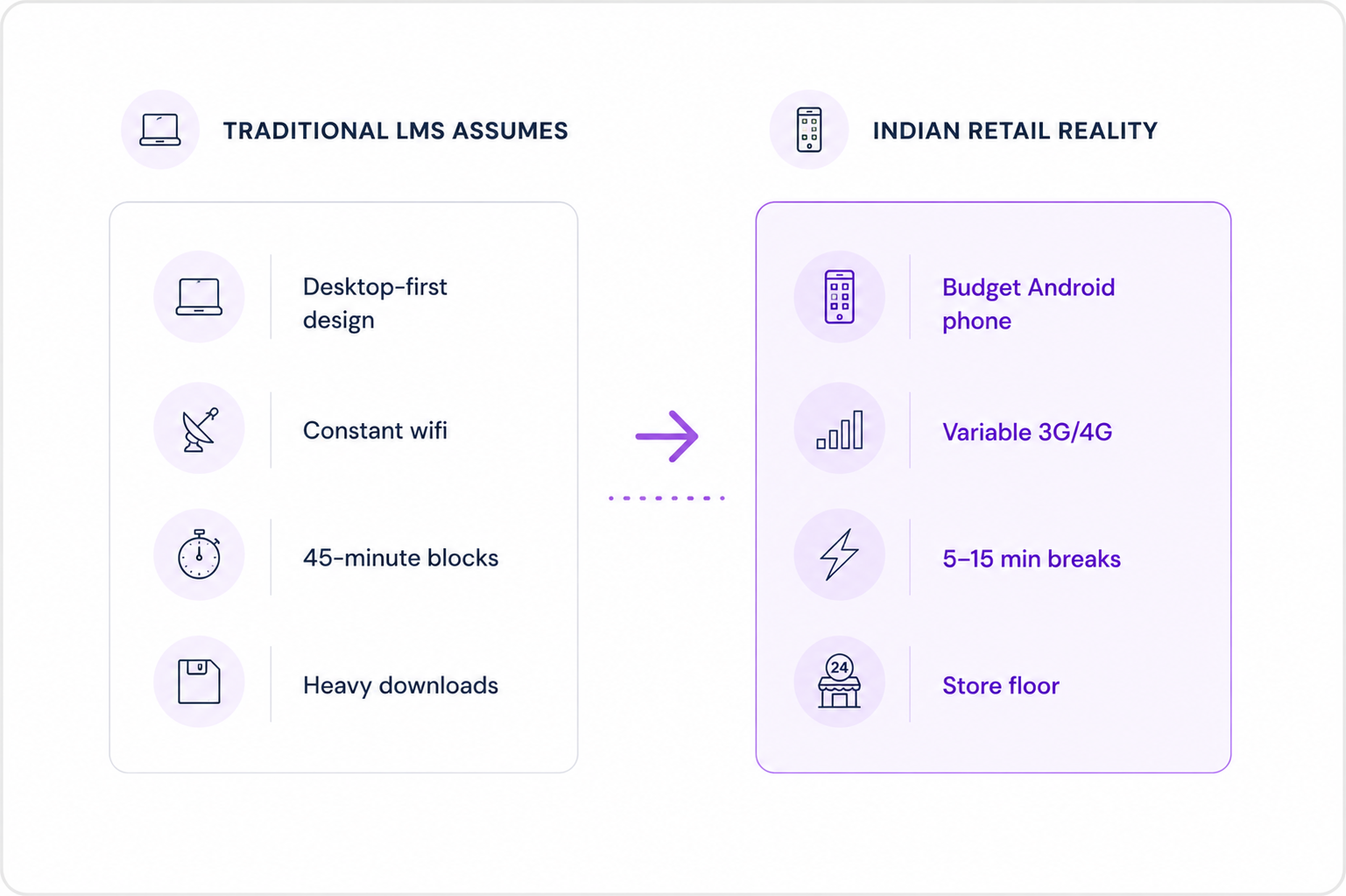
Problem 1: Connectivity Isn't Consistent
A retail associate in an urban store might have strong 4G. An associate in a Tier-2 or Tier-3 location might have intermittent 3G. A system that requires constant connection frustrates users. Users stop using it.
Problem 2: Device Constraints Are Real
Budget phones have limited storage (16-32GB shared between apps, photos, personal data). A heavy, video-intensive app won't download. If it does, it gets uninstalled to free up space.
Problem 3: Time Structures Don't Match
Office training assumes 30-60 minute learning blocks. Retail work happens in 5-15 minute blocks. A 45-minute course doesn't fit into a retail shift's actual rhythm.
Problem 4: Mobile Design Matters
Not all apps are designed equally for mobile. An interface built for mouse-and-keyboard doesn't work well on a phone without keyboard. Scrolling is frustrating. Buttons are too small. Users abandon it.
"Mobile-first" isn't just "works on phones." It's a design philosophy where the platform is built for phones first, desktops second (if at all).
This changes three fundamental things:
1. Content Structure
Mobile-first content is designed in chunks:
This fits retail's actual work rhythm. Staff can complete one module during a break, not need a full hour.
2. Interface Design
Mobile-first interfaces are built for:
This reduces friction. Staff can navigate quickly, not get lost in menus.
3. Performance
Mobile-first platforms are built to:
This works in actual retail conditions, not ideal conditions.
Three structural factors make mobile-first training essential for Indian retail:
1. Device Economics
Indian retail staff predominantly use budget phones (₹5,000-20,000). These phones:
A lightweight app is non-negotiable. It has to work on these actual devices, not aspirational devices.
2. Connectivity Reality
India's mobile network coverage is widespread, but consistency varies. Urban 4G is common. Semi-urban 3G is common. Rural areas have mixed 2G/3G. Peak hours see congestion.
A system designed for Indian retail needs to handle variable connectivity, not assume constant connection.
3. Time Economics
Indian retail staff work long shifts (8-10 hours) with compressed breaks. They can't do unpaid training after their shift. Training has to happen during work, in short blocks.
A 7-minute module fits into a break. A 45-minute course doesn't.
Consider a store manager at a 50-store retail chain in India.
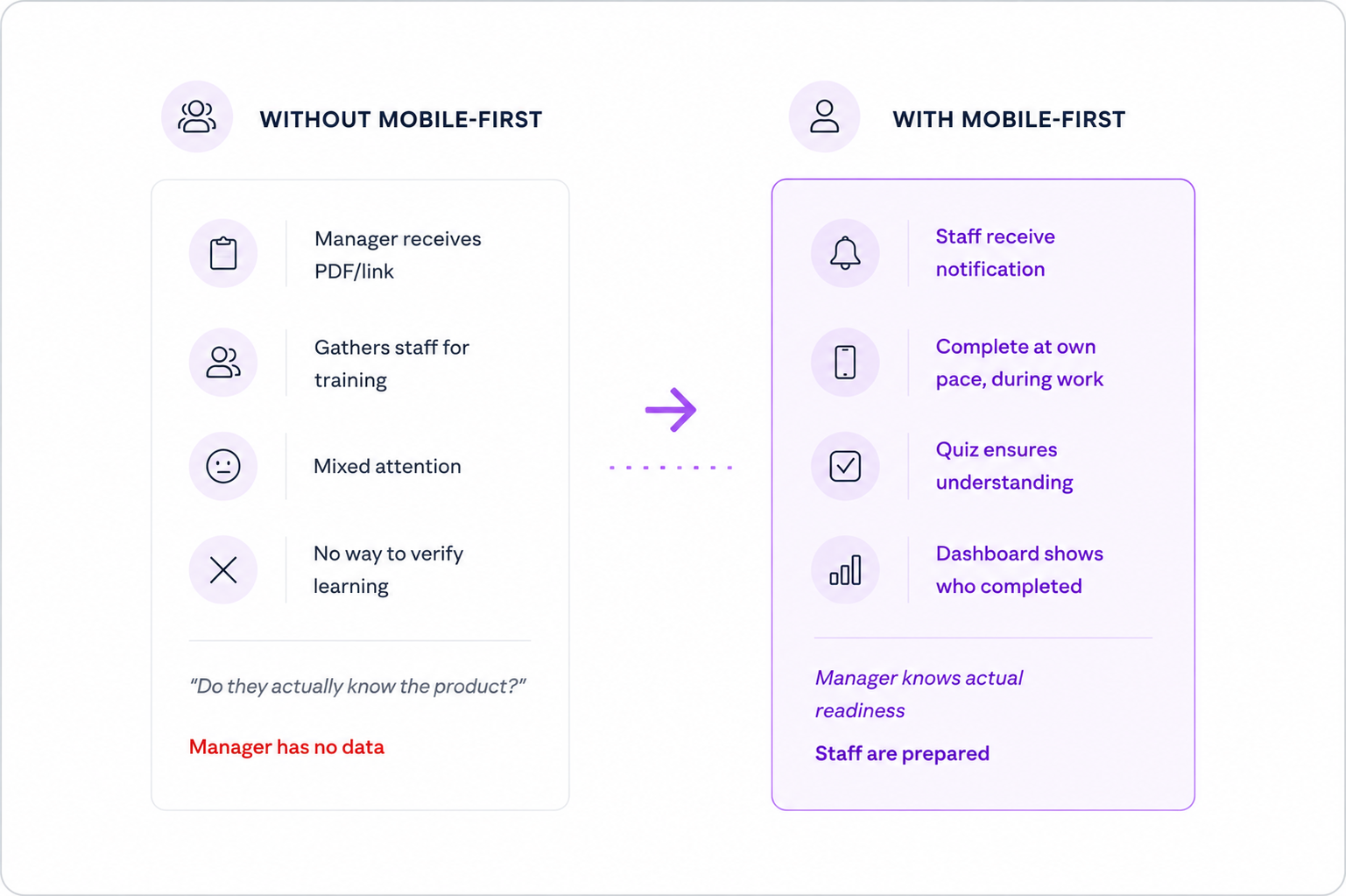
Without mobile-first approach:
With mobile-first approach:
The difference: Visibility into actual learning, not hope-based assumptions.
1. Optimized for Small Screens
Content is readable on small phone screens without constant zooming or horizontal scrolling. Text is large enough. Buttons are tap-friendly (not tiny).
2. Designed for Intermittent Use
Staff can pause mid-lesson and resume exactly where they left. No losing progress to a logout or app crash. The system saves state automatically.
3. Data-Efficient
The platform uses minimal mobile data. Images are compressed. Videos are optimized. Staff with limited data plans can still use it.
4. Works on Varied Devices
The platform runs on older Android versions (not just the latest). Works on phones with 1GB RAM (not just 4GB+). Handles budget devices, not just flagship phones.
5. Clear Progress Tracking
Staff see their own progress. Managers see their team's progress. No mystery about who's trained and who isn't.
6. Micro-Learning Structure
Training is designed in small, completable units. One concept. One quiz. Done. Not 60-minute marathons.
When Indian retail chains implement mobile-first training design:
Training Completion Rates Improve
Staff are more likely to complete training when it fits their work reality (5-15 minute blocks) rather than requiring unpaid study time or blocked-off hours.
Knowledge Retention Improves
Spaced learning (multiple small sessions over time) typically improves retention compared to single long sessions. Mobile-first encourages spaced learning naturally. Frontlyne's daily quiz feature reinforces learning through repeated micro-assessments, helping staff retain knowledge longer without requiring additional class time.
Manager Visibility Improves
Store managers have actual data on who trained and who didn't, not assumptions. This enables manager accountability.
Consistency Improves Across Locations
Every store's staff see the same training content. Delivered the same way. No variation based on store manager's training ability.
Challenge 1: Language Diversity
India has 22 official languages. A 500-store chain might need training in 5-8 languages depending on geography.
Mobile-first solution: Support learning in multiple languages. Device language settings can determine which language the user sees. Frontlyne's auto-translate feature translates assessments into multiple languages, ensuring staff can be assessed in their native language without creating separate test versions. This reduces production time and ensures consistency across language regions.
Challenge 2: Device Diversity
Staff use different phones. Different ages. Different storage capacity. Some have 2GB RAM. Some have 4GB RAM. Some phones are 3-4 years old.
Mobile-first solution: Platform works across this diversity. Not optimized for newest phones only. Built for actual Indian device ecosystem.
Challenge 3: Connectivity Variability
Connectivity varies by location and time. Morning might be strong 4G. Afternoon might be weak 3G. Peak shopping hours might see congestion.
Mobile-first solution: Platform handles variable connectivity gracefully. Not designed for constant high-speed connection.
Challenge 4: Time Constraints
Staff work long shifts with minimal downtime. Unpaid training (before/after shift) has low adoption.
Mobile-first solution: Training fits into actual work time. 5-minute modules can be completed during natural breaks. Frontlyne's auto-assign feature ensures relevant training reaches staff automatically based on their role and store location, eliminating the need for managers to manually push training. Staff see what they need to complete without friction.
You now know:
Your next question: When you train new staff, how do you verify they actually understood the training? If the answer is uncertain, mobile-first training with visible completion and quiz data provides that clarity.
See how Frontlyne's platform is designed for mobile-first delivery, works on budget devices, handles variable connectivity, gives managers visibility into actual staff learning (not assumptions), and uses in-video assessments and AI-generated assessments to verify knowledge without requiring separate testing sessions.


Training retail staff in India requires infrastructure that most traditional learning platforms don't have.
Most learning management systems were built for office environments: employees with laptops, reliable wifi, desktop notifications, email access. Indian retail has none of these.
A store associate works an 8-hour shift on a budget Android phone (₹5,000-20,000 range). They don't check email. They're not sitting at a desk. Data connectivity fluctuates depending on location and time of day.
Traditional LMS platforms assume consistent, desktop-first access. Indian retail needs something different.
A traditional LMS says: "Training is available online. Access it on your device during breaks."
The reality in Indian retail stores:
Problem 1: Connectivity Isn't Consistent
A retail associate in an urban store might have strong 4G. An associate in a Tier-2 or Tier-3 location might have intermittent 3G. A system that requires constant connection frustrates users. Users stop using it.
Problem 2: Device Constraints Are Real
Budget phones have limited storage (16-32GB shared between apps, photos, personal data). A heavy, video-intensive app won't download. If it does, it gets uninstalled to free up space.
Problem 3: Time Structures Don't Match
Office training assumes 30-60 minute learning blocks. Retail work happens in 5-15 minute blocks. A 45-minute course doesn't fit into a retail shift's actual rhythm.
Problem 4: Mobile Design Matters
Not all apps are designed equally for mobile. An interface built for mouse-and-keyboard doesn't work well on a phone without keyboard. Scrolling is frustrating. Buttons are too small. Users abandon it.
"Mobile-first" isn't just "works on phones." It's a design philosophy where the platform is built for phones first, desktops second (if at all).
This changes three fundamental things:
1. Content Structure
Mobile-first content is designed in chunks:
This fits retail's actual work rhythm. Staff can complete one module during a break, not need a full hour.
2. Interface Design
Mobile-first interfaces are built for:
This reduces friction. Staff can navigate quickly, not get lost in menus.
3. Performance
Mobile-first platforms are built to:
This works in actual retail conditions, not ideal conditions.
Three structural factors make mobile-first training essential for Indian retail:
1. Device Economics
Indian retail staff predominantly use budget phones (₹5,000-20,000). These phones:
A lightweight app is non-negotiable. It has to work on these actual devices, not aspirational devices.
2. Connectivity Reality
India's mobile network coverage is widespread, but consistency varies. Urban 4G is common. Semi-urban 3G is common. Rural areas have mixed 2G/3G. Peak hours see congestion.
A system designed for Indian retail needs to handle variable connectivity, not assume constant connection.
3. Time Economics
Indian retail staff work long shifts (8-10 hours) with compressed breaks. They can't do unpaid training after their shift. Training has to happen during work, in short blocks.
A 7-minute module fits into a break. A 45-minute course doesn't.
Consider a store manager at a 50-store retail chain in India.
Without mobile-first approach:
With mobile-first approach:
The difference: Visibility into actual learning, not hope-based assumptions.
1. Optimized for Small Screens
Content is readable on small phone screens without constant zooming or horizontal scrolling. Text is large enough. Buttons are tap-friendly (not tiny).
2. Designed for Intermittent Use
Staff can pause mid-lesson and resume exactly where they left. No losing progress to a logout or app crash. The system saves state automatically.
3. Data-Efficient
The platform uses minimal mobile data. Images are compressed. Videos are optimized. Staff with limited data plans can still use it.
4. Works on Varied Devices
The platform runs on older Android versions (not just the latest). Works on phones with 1GB RAM (not just 4GB+). Handles budget devices, not just flagship phones.
5. Clear Progress Tracking
Staff see their own progress. Managers see their team's progress. No mystery about who's trained and who isn't.
6. Micro-Learning Structure
Training is designed in small, completable units. One concept. One quiz. Done. Not 60-minute marathons.
When Indian retail chains implement mobile-first training design:
Training Completion Rates Improve
Staff are more likely to complete training when it fits their work reality (5-15 minute blocks) rather than requiring unpaid study time or blocked-off hours.
Knowledge Retention Improves
Spaced learning (multiple small sessions over time) typically improves retention compared to single long sessions. Mobile-first encourages spaced learning naturally. Frontlyne's daily quiz feature reinforces learning through repeated micro-assessments, helping staff retain knowledge longer without requiring additional class time.
Manager Visibility Improves
Store managers have actual data on who trained and who didn't, not assumptions. This enables manager accountability.
Consistency Improves Across Locations
Every store's staff see the same training content. Delivered the same way. No variation based on store manager's training ability.
Challenge 1: Language Diversity
India has 22 official languages. A 500-store chain might need training in 5-8 languages depending on geography.
Mobile-first solution: Support learning in multiple languages. Device language settings can determine which language the user sees. Frontlyne's auto-translate feature translates assessments into multiple languages, ensuring staff can be assessed in their native language without creating separate test versions. This reduces production time and ensures consistency across language regions.
Challenge 2: Device Diversity
Staff use different phones. Different ages. Different storage capacity. Some have 2GB RAM. Some have 4GB RAM. Some phones are 3-4 years old.
Mobile-first solution: Platform works across this diversity. Not optimized for newest phones only. Built for actual Indian device ecosystem.
Challenge 3: Connectivity Variability
Connectivity varies by location and time. Morning might be strong 4G. Afternoon might be weak 3G. Peak shopping hours might see congestion.
Mobile-first solution: Platform handles variable connectivity gracefully. Not designed for constant high-speed connection.
Challenge 4: Time Constraints
Staff work long shifts with minimal downtime. Unpaid training (before/after shift) has low adoption.
Mobile-first solution: Training fits into actual work time. 5-minute modules can be completed during natural breaks. Frontlyne's auto-assign feature ensures relevant training reaches staff automatically based on their role and store location, eliminating the need for managers to manually push training. Staff see what they need to complete without friction.
You now know:
Your next question: When you train new staff, how do you verify they actually understood the training? If the answer is uncertain, mobile-first training with visible completion and quiz data provides that clarity.
See how Frontlyne's platform is designed for mobile-first delivery, works on budget devices, handles variable connectivity, gives managers visibility into actual staff learning (not assumptions), and uses in-video assessments and AI-generated assessments to verify knowledge without requiring separate testing sessions.
Join the brands building better frontline workforces. Live in 50 days. No IT complexity. Dedicated support from day one.



.jpg)


.png)


%20-%20Copy.png)


.jpg)
.jpg)
.png)
.png)
.png)
.png)