By
Sanjana Chavali
July 20, 2026
•
6
min read
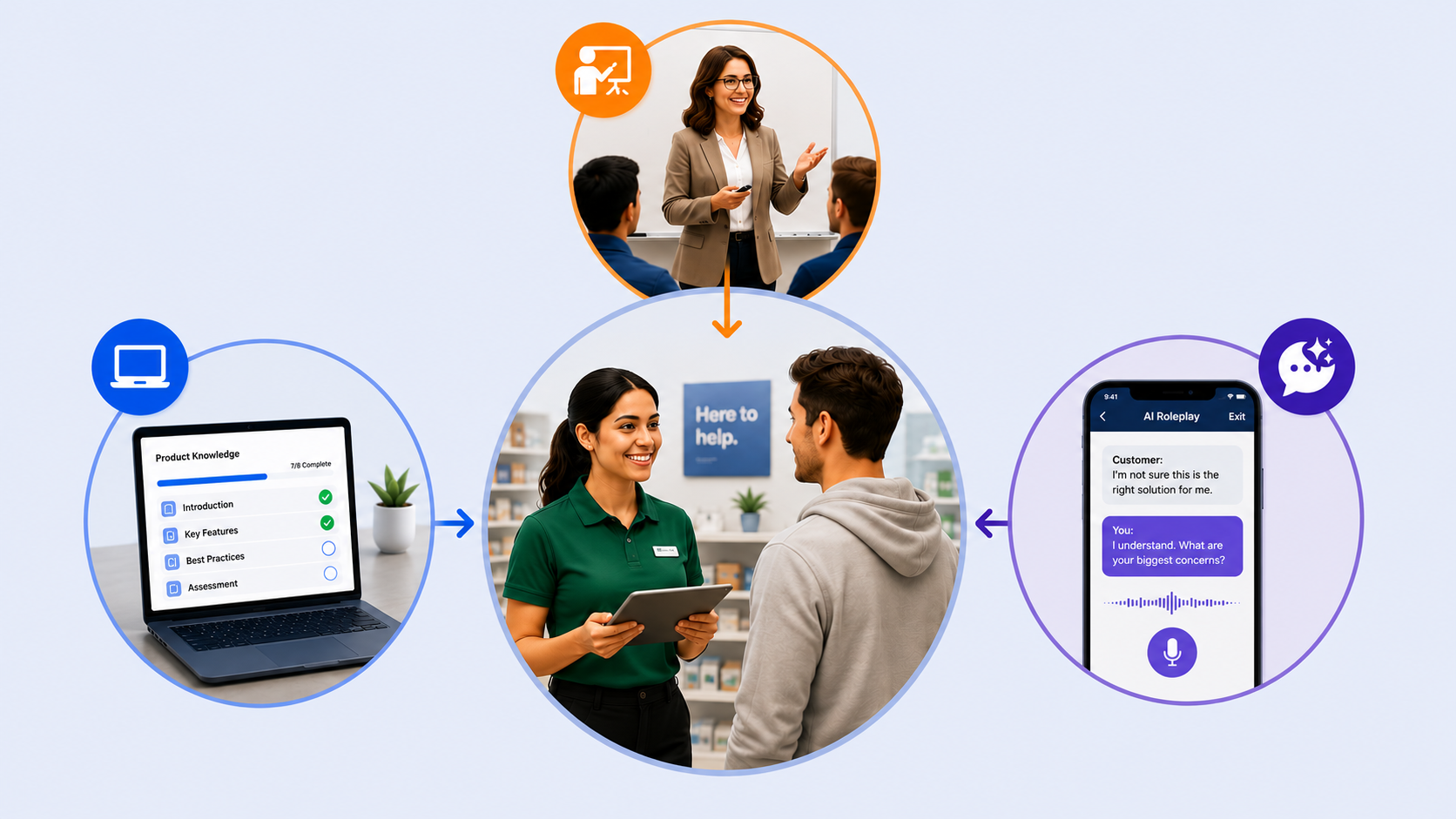
Ask most retail L&D leaders in 2026 where their budget should go, and the conversation quickly turns into a debate: more instructor-led training (ILT), or more digital, self-paced learning? It's usually framed as a competition, with one format expected to win and the other to fade out. That framing doesn't hold up once you actually look at what each format is good at, and where each one quietly breaks down at scale.
Instructor-led training earns its place for one reason above all others: a real person, in the room or on the call, can adapt on the spot. If half the group looks lost, a trainer can slow down, rephrase, or pull in an example that wasn't in the deck. That's a genuine advantage, particularly for:
But ILT has structural costs that tend to surface only after the fact, not on the training budget spreadsheet upfront:
Digital training flips the equation: it scales consistently. The same module, the same certification bar, delivered identically whether the location is a flagship store or a small-format outlet three states away. Its real strengths:
Where digital training runs into trouble isn't reach, it's depth. A module can confirm someone sat through the content and answered a quiz correctly, but it was never designed to test whether that person can hold a real, live, two-sided conversation, an objection, a complaint, a negotiation, under normal working conditions. That's a different skill, and no static video or quiz was built to develop it.
The debate softens considerably once you stop asking which format should win and start asking what job each one is actually built to do.
One way to think about it:
The strongest frontline training programs don't choose one format over another. They use each where it creates the most value.
The organizations getting this right in 2026 aren't picking a side. They're sequencing formats by what each one is actually built for:
That isn't a compromise. As digital and AI-enabled training take over the repeatable, high-volume parts of the curriculum, in-person time gets freed up for the moments that actually benefit from a trainer being present:
That's a better use of a trainer's time than repeating the same product walkthrough for the fifth cohort this quarter, and it's a better use of the budget too.
That's the piece most training stacks still skip entirely.
Neither a classroom session nor a digital module gives a frontliner a place to actually rehearse a conversation before having it for real. Frontlyne AI Roleplays is designed for that missing layer. It lets frontline teams practise real customer and internal conversations, scenario by scenario, with a few things that neither ILT nor a static module can offer at scale:
It's not a replacement for a good trainer, and it's not just another module to click through. It's the rehearsal step, something between "here's the policy" and "handle it live," that most training programs have never had a scalable way to offer.
Roleplay practice closes the gap on the conversation itself: what to say, how to say it, how to handle pushback, and it does that well. The interesting question is what comes next: a real interaction doesn't happen in a vacuum, it happens inside a store, on a shift, with the physical conditions of the floor shaping how it actually unfolds. That's worth thinking about as the natural extension of what rehearsal could eventually cover.
One direction we find interesting, and worth exploring further, is simulating the environment a conversation happens in, not just the conversation itself: the queue, the noise, the shift chaos that shapes how a conversation actually plays out on the floor. Conversational practice is quickly becoming table stakes; the environment around it is the natural next frontier.
As organizations increasingly combine digital learning, instructor-led training, assessments, certifications, and AI practice, the challenge shifts from choosing a format to managing all of them consistently across the frontline.
Most of this tradeoff only exists because training teams have historically managed ILT, digital learning, assessments, and certifications across separate systems, with separate scheduling, separate reporting, and no shared view of who actually learned what. That's less true by the day.
Frontlyne brings those pieces together. Live and virtual sessions, pre and post-assessments, structured content, certifications, and AI Roleplays all sit in one platform, giving training managers a single learner record instead of disconnected systems.
The open question worth watching isn't which format wins. It's how far rehearsal itself can go, from practising the conversation today, to eventually simulating the environment it happens in.


Ask most retail L&D leaders in 2026 where their budget should go, and the conversation quickly turns into a debate: more instructor-led training (ILT), or more digital, self-paced learning? It's usually framed as a competition, with one format expected to win and the other to fade out. That framing doesn't hold up once you actually look at what each format is good at, and where each one quietly breaks down at scale.
Instructor-led training earns its place for one reason above all others: a real person, in the room or on the call, can adapt on the spot. If half the group looks lost, a trainer can slow down, rephrase, or pull in an example that wasn't in the deck. That's a genuine advantage, particularly for:
But ILT has structural costs that tend to surface only after the fact, not on the training budget spreadsheet upfront:
Digital training flips the equation: it scales consistently. The same module, the same certification bar, delivered identically whether the location is a flagship store or a small-format outlet three states away. Its real strengths:
Where digital training runs into trouble isn't reach, it's depth. A module can confirm someone sat through the content and answered a quiz correctly, but it was never designed to test whether that person can hold a real, live, two-sided conversation, an objection, a complaint, a negotiation, under normal working conditions. That's a different skill, and no static video or quiz was built to develop it.
The debate softens considerably once you stop asking which format should win and start asking what job each one is actually built to do.
One way to think about it:
The strongest frontline training programs don't choose one format over another. They use each where it creates the most value.
The organizations getting this right in 2026 aren't picking a side. They're sequencing formats by what each one is actually built for:
That isn't a compromise. As digital and AI-enabled training take over the repeatable, high-volume parts of the curriculum, in-person time gets freed up for the moments that actually benefit from a trainer being present:
That's a better use of a trainer's time than repeating the same product walkthrough for the fifth cohort this quarter, and it's a better use of the budget too.
That's the piece most training stacks still skip entirely.
Neither a classroom session nor a digital module gives a frontliner a place to actually rehearse a conversation before having it for real. Frontlyne AI Roleplays is designed for that missing layer. It lets frontline teams practise real customer and internal conversations, scenario by scenario, with a few things that neither ILT nor a static module can offer at scale:
It's not a replacement for a good trainer, and it's not just another module to click through. It's the rehearsal step, something between "here's the policy" and "handle it live," that most training programs have never had a scalable way to offer.
Roleplay practice closes the gap on the conversation itself: what to say, how to say it, how to handle pushback, and it does that well. The interesting question is what comes next: a real interaction doesn't happen in a vacuum, it happens inside a store, on a shift, with the physical conditions of the floor shaping how it actually unfolds. That's worth thinking about as the natural extension of what rehearsal could eventually cover.
One direction we find interesting, and worth exploring further, is simulating the environment a conversation happens in, not just the conversation itself: the queue, the noise, the shift chaos that shapes how a conversation actually plays out on the floor. Conversational practice is quickly becoming table stakes; the environment around it is the natural next frontier.
As organizations increasingly combine digital learning, instructor-led training, assessments, certifications, and AI practice, the challenge shifts from choosing a format to managing all of them consistently across the frontline.
Most of this tradeoff only exists because training teams have historically managed ILT, digital learning, assessments, and certifications across separate systems, with separate scheduling, separate reporting, and no shared view of who actually learned what. That's less true by the day.
Frontlyne brings those pieces together. Live and virtual sessions, pre and post-assessments, structured content, certifications, and AI Roleplays all sit in one platform, giving training managers a single learner record instead of disconnected systems.
The open question worth watching isn't which format wins. It's how far rehearsal itself can go, from practising the conversation today, to eventually simulating the environment it happens in.
Join the brands building better frontline workforces. Live in 50 days. No IT complexity. Dedicated support from day one.




.png)


.jpg)




.jpg)