By
Sanjana Chavali
July 9, 2026
•
6
min read
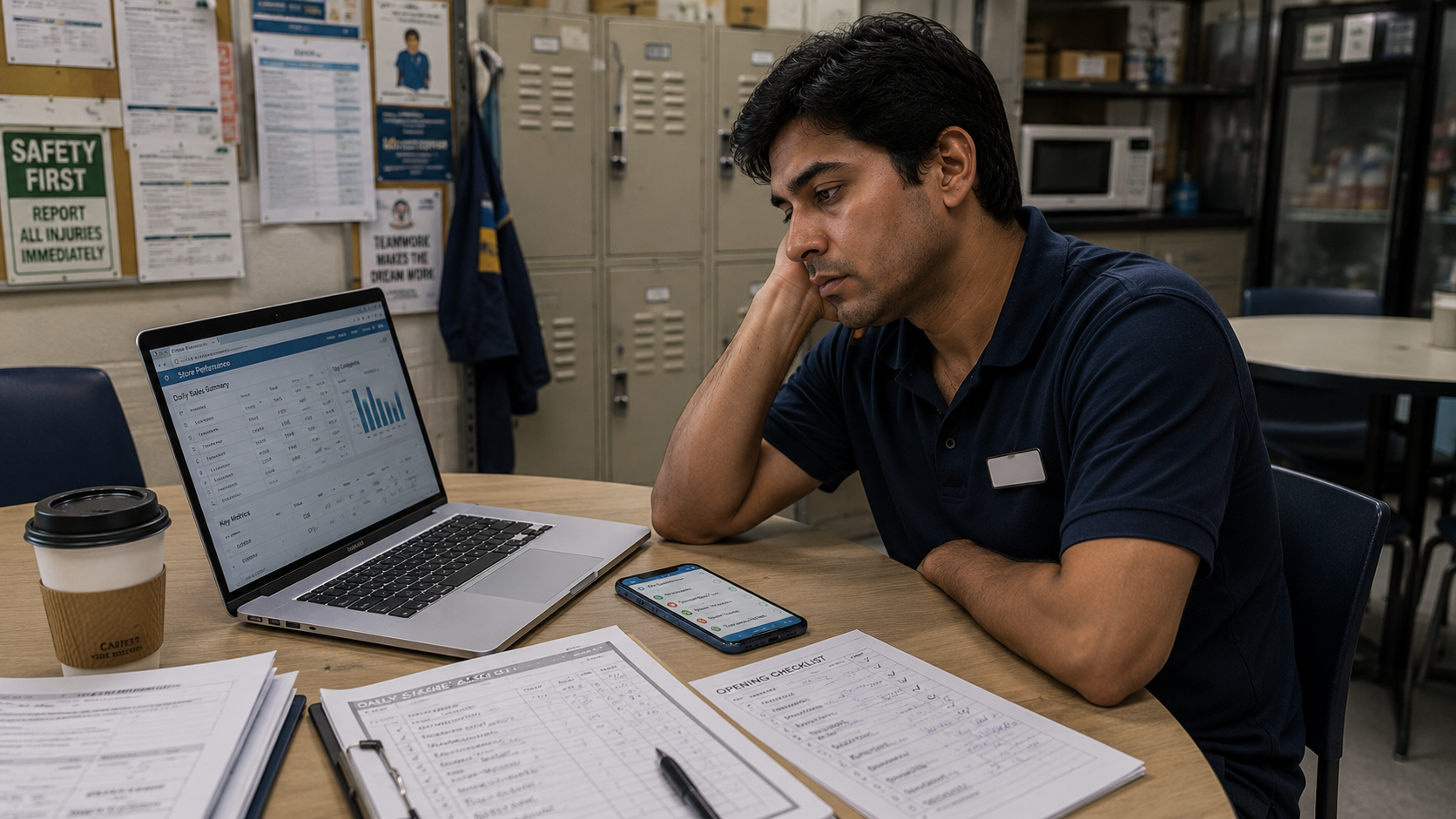
We build technology for frontline teams, which means most weeks involve a conversation with someone evaluating their frontline tech stack: sometimes ours, sometimes someone else's, sometimes the idea of building something internally with their own team. Over the last five years, a pattern has become hard to miss, and it felt worth writing down plainly. This isn't an argument for one app over five. It's what we've observed, consistently, as the market around LMS for frontline teams and frontline enablement tools has matured.
There have always been two broad ways to build a frontline tech stack, and each comes with its own set of benefits.
The first is best-of-breed: pick the strongest available tool for each function (a dedicated LMS for training, a separate tool for audits and operations, another for rewards and recognition), and connect them as needed. Each tool gets to be excellent at exactly one job, built by a team that thinks about nothing else.
The second is a unified platform: learning, operations, career progression, and recognition, living together in one place, built to function as a single system rather than a set of connected parts. Every function still gets to be sharp; the difference is that they also talk to each other, so the whole picture stays readable at a glance, without anyone needing to translate between systems.
Both are legitimate ways to build a stack, at least on paper. What's changed isn't which one looks correct in a slide deck. It's the question buyers are now asking before they choose between them.
A few years ago, the main question a buyer asked was straightforward: does this tool do X, Y, and Z well. That question hasn't disappeared, but it's no longer the first one.
Increasingly, the first question we hear is this: if two systems disagree about a number (attendance completion in one place, audit scores in another, performance ratings somewhere else entirely), who do we believe, and how quickly can we find out which one is right? That's not a features question. It's a question about ownership of data, and it tends to surface only after a team has actually lived inside a fragmented stack for a while, long enough to have hit the moment where two dashboards told two different stories about the same store, the same associate, the same week.
This is a meaningfully different kind of diligence than what buyers used to bring to the table, and it says something about where the frontline software category actually is right now: past the feature-comparison stage, and into the operational-truth stage.
Buyers now tell us that if they were starting from scratch today, they'd choose one platform for their core frontline needs over a handful of disconnected, specialised tools. That lines up with what we hear directly, often enough that it reads less like an opinion and more like something the market has been quietly indicating for a while now.
That question about data ownership matters because of where it eventually leads: time. Specifically, whose time gets spent finding the answer.
Years ago, when we were first building in this space, we noticed HR and L&D teams spending a significant share of their time (we estimate around 40 percent) on administrative work: pulling data into spreadsheets from different sources, running training or audits offline, then manually stitching together reports for leadership. At the time, that read mostly as a feature gap. The tools available simply weren't built with frontline realities in mind, so people filled the gaps by hand.
What we notice now is a version of that same time cost, in a different shape. It's less about missing features and more about reconciliation: checking whether the LMS, the ops tool, and the HR system agree with each other, and if they don't, tracing back to find out which one is right. The type of admin work has changed. The underlying time cost hasn't gone anywhere. It has simply moved from the front of the process (getting the data in) to the back of it (making sure the data tells a cohesive story once it's there).
For a long time, the coordination cost between systems was treated as background noise, something operations teams simply absorbed without giving it a name. It doesn't read that way anymore to the buyers we talk to. It reads as a real, measurable cost: slower reporting, slower decisions, and a quiet erosion of trust that sets in the moment two systems disagree and nobody can say why with confidence.
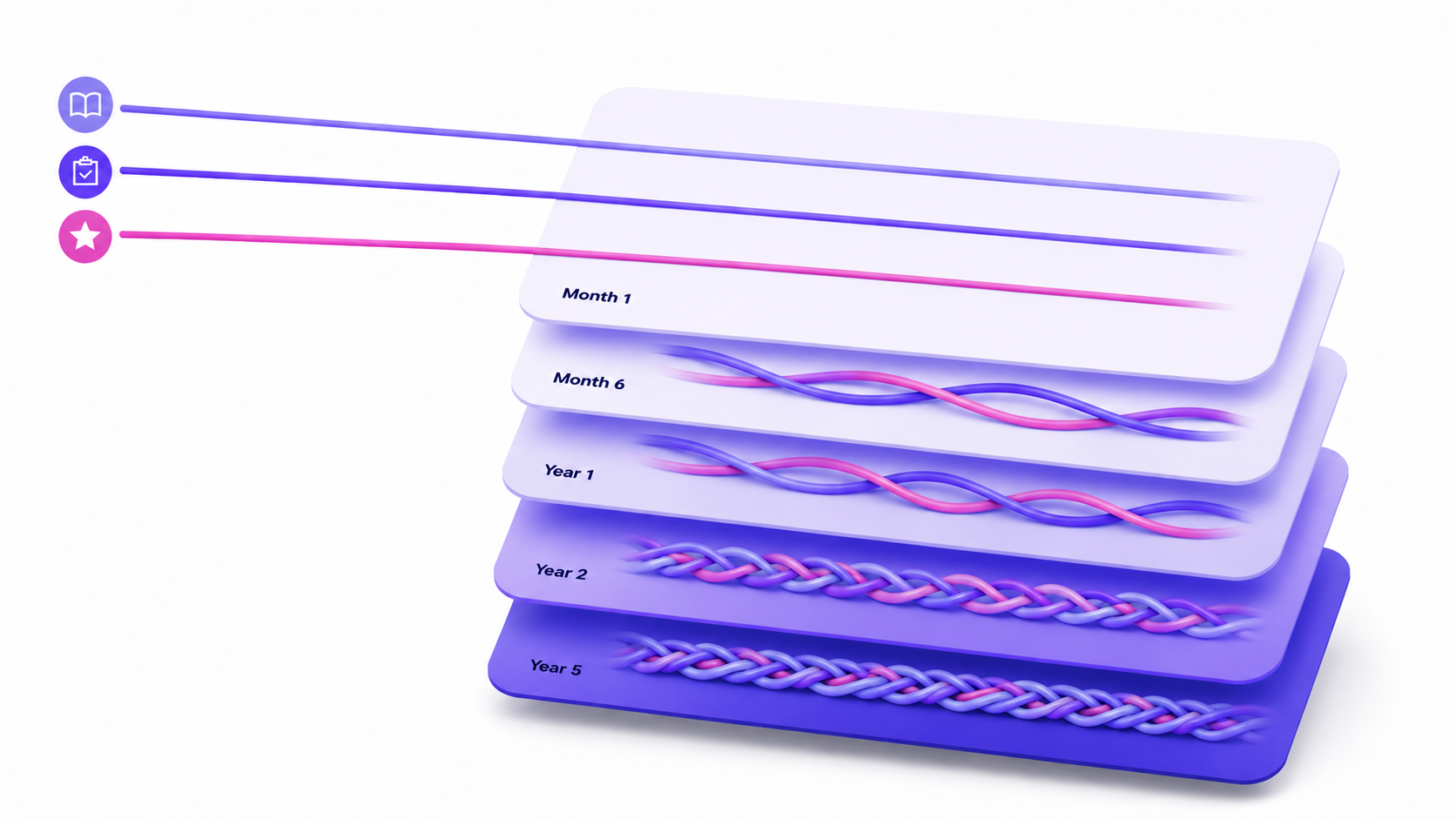
But the coordination cost is only half of what's at stake, and arguably the less interesting half. The part that gets less attention is what fragmentation does to the frontliner sitting underneath all these systems. A single associate, on a single shift, is really just one person. But open three different apps to manage them (one for training, one for operations, one trying, somewhat awkwardly, to track career growth) and that one person becomes three separate profiles, three logins, three partial pictures that never quite add up to the whole employee.
A single, connected platform doesn't just resolve which dashboard to trust. It gives that frontliner one identity: one place where their training, their performance on the floor, and their career trajectory sit together, visible to them and to the people managing them, without anyone needing to reconcile three versions of the same person by hand. That's a different kind of benefit than fixing a reporting delay. It changes what the frontliner actually experiences, day to day, and it's the piece most best-of-breed conversations never quite get around to addressing.
None of this means specialized tools stop having a place. But the organisations moving fastest right now are the ones who've stopped treating coordination cost, and the fractured identity it creates for the person on the floor, as an acceptable cost of doing business. They're solving for it directly, with a single connected system built to hold the whole picture, rather than routing around the problem indefinitely with better integrations between separate parts.
That's the shift we've watched happen over five years of these conversations, and it's shaping up to be one of the more consequential ones in how frontline teams get built.
This is part of why we built Frontlyne as a frontline superapp: learning, operations, career progression, and recognition, living together in one platform, giving every frontliner a single identity rather than three fragmented ones. We didn't build it to win an argument about best-of-breed versus unified. We built it because we kept watching that 40 percent of admin time, and the frontliner caught underneath it, pay the price for a stack that was never designed to be whole.
If you're in the middle of thinking through your own frontline stack, whether that means comparing tools or simply trying to understand where your team's time (and your frontliner's identity) is actually going, we'd be glad to talk it through.


We build technology for frontline teams, which means most weeks involve a conversation with someone evaluating their frontline tech stack: sometimes ours, sometimes someone else's, sometimes the idea of building something internally with their own team. Over the last five years, a pattern has become hard to miss, and it felt worth writing down plainly. This isn't an argument for one app over five. It's what we've observed, consistently, as the market around LMS for frontline teams and frontline enablement tools has matured.
There have always been two broad ways to build a frontline tech stack, and each comes with its own set of benefits.
The first is best-of-breed: pick the strongest available tool for each function (a dedicated LMS for training, a separate tool for audits and operations, another for rewards and recognition), and connect them as needed. Each tool gets to be excellent at exactly one job, built by a team that thinks about nothing else.
The second is a unified platform: learning, operations, career progression, and recognition, living together in one place, built to function as a single system rather than a set of connected parts. Every function still gets to be sharp; the difference is that they also talk to each other, so the whole picture stays readable at a glance, without anyone needing to translate between systems.
Both are legitimate ways to build a stack, at least on paper. What's changed isn't which one looks correct in a slide deck. It's the question buyers are now asking before they choose between them.
A few years ago, the main question a buyer asked was straightforward: does this tool do X, Y, and Z well. That question hasn't disappeared, but it's no longer the first one.
Increasingly, the first question we hear is this: if two systems disagree about a number (attendance completion in one place, audit scores in another, performance ratings somewhere else entirely), who do we believe, and how quickly can we find out which one is right? That's not a features question. It's a question about ownership of data, and it tends to surface only after a team has actually lived inside a fragmented stack for a while, long enough to have hit the moment where two dashboards told two different stories about the same store, the same associate, the same week.
This is a meaningfully different kind of diligence than what buyers used to bring to the table, and it says something about where the frontline software category actually is right now: past the feature-comparison stage, and into the operational-truth stage.
Buyers now tell us that if they were starting from scratch today, they'd choose one platform for their core frontline needs over a handful of disconnected, specialised tools. That lines up with what we hear directly, often enough that it reads less like an opinion and more like something the market has been quietly indicating for a while now.
That question about data ownership matters because of where it eventually leads: time. Specifically, whose time gets spent finding the answer.
Years ago, when we were first building in this space, we noticed HR and L&D teams spending a significant share of their time (we estimate around 40 percent) on administrative work: pulling data into spreadsheets from different sources, running training or audits offline, then manually stitching together reports for leadership. At the time, that read mostly as a feature gap. The tools available simply weren't built with frontline realities in mind, so people filled the gaps by hand.
What we notice now is a version of that same time cost, in a different shape. It's less about missing features and more about reconciliation: checking whether the LMS, the ops tool, and the HR system agree with each other, and if they don't, tracing back to find out which one is right. The type of admin work has changed. The underlying time cost hasn't gone anywhere. It has simply moved from the front of the process (getting the data in) to the back of it (making sure the data tells a cohesive story once it's there).
For a long time, the coordination cost between systems was treated as background noise, something operations teams simply absorbed without giving it a name. It doesn't read that way anymore to the buyers we talk to. It reads as a real, measurable cost: slower reporting, slower decisions, and a quiet erosion of trust that sets in the moment two systems disagree and nobody can say why with confidence.
But the coordination cost is only half of what's at stake, and arguably the less interesting half. The part that gets less attention is what fragmentation does to the frontliner sitting underneath all these systems. A single associate, on a single shift, is really just one person. But open three different apps to manage them (one for training, one for operations, one trying, somewhat awkwardly, to track career growth) and that one person becomes three separate profiles, three logins, three partial pictures that never quite add up to the whole employee.
A single, connected platform doesn't just resolve which dashboard to trust. It gives that frontliner one identity: one place where their training, their performance on the floor, and their career trajectory sit together, visible to them and to the people managing them, without anyone needing to reconcile three versions of the same person by hand. That's a different kind of benefit than fixing a reporting delay. It changes what the frontliner actually experiences, day to day, and it's the piece most best-of-breed conversations never quite get around to addressing.
None of this means specialized tools stop having a place. But the organisations moving fastest right now are the ones who've stopped treating coordination cost, and the fractured identity it creates for the person on the floor, as an acceptable cost of doing business. They're solving for it directly, with a single connected system built to hold the whole picture, rather than routing around the problem indefinitely with better integrations between separate parts.
That's the shift we've watched happen over five years of these conversations, and it's shaping up to be one of the more consequential ones in how frontline teams get built.
This is part of why we built Frontlyne as a frontline superapp: learning, operations, career progression, and recognition, living together in one platform, giving every frontliner a single identity rather than three fragmented ones. We didn't build it to win an argument about best-of-breed versus unified. We built it because we kept watching that 40 percent of admin time, and the frontliner caught underneath it, pay the price for a stack that was never designed to be whole.
If you're in the middle of thinking through your own frontline stack, whether that means comparing tools or simply trying to understand where your team's time (and your frontliner's identity) is actually going, we'd be glad to talk it through.
Join the brands building better frontline workforces. Live in 50 days. No IT complexity. Dedicated support from day one.


.png)
.png)


.jpg)
.png)
.jpg)


.jpg)
.webp)


.jpg)

.jpg)



.png)
.jpg)
.png)