By
Sanjana Chavali
June 29, 2026
•
8
min read

Over the last few weeks, this blog has covered the costs that pile up when frontline processes are fragmented: missed sales, retraining cycles, attrition that compounds quietly over time.
Today, we want to talk about the flip side. What does it actually look like when HR, L&D, and Ops work as one? What does the frontliner feel when that alignment exists? And what does the organisation look like when it has deliberately built toward that?
That picture is worth spelling out carefully, because it is both more achievable and more specific than most people expect.
The Frontliner Has One Experience, Not Three
In organisations that have figured this out, the starting point is a deceptively simple design principle: the frontliner should never feel like they are being managed by three separate functions with three separate agendas.
This sounds obvious. It is surprisingly rare.
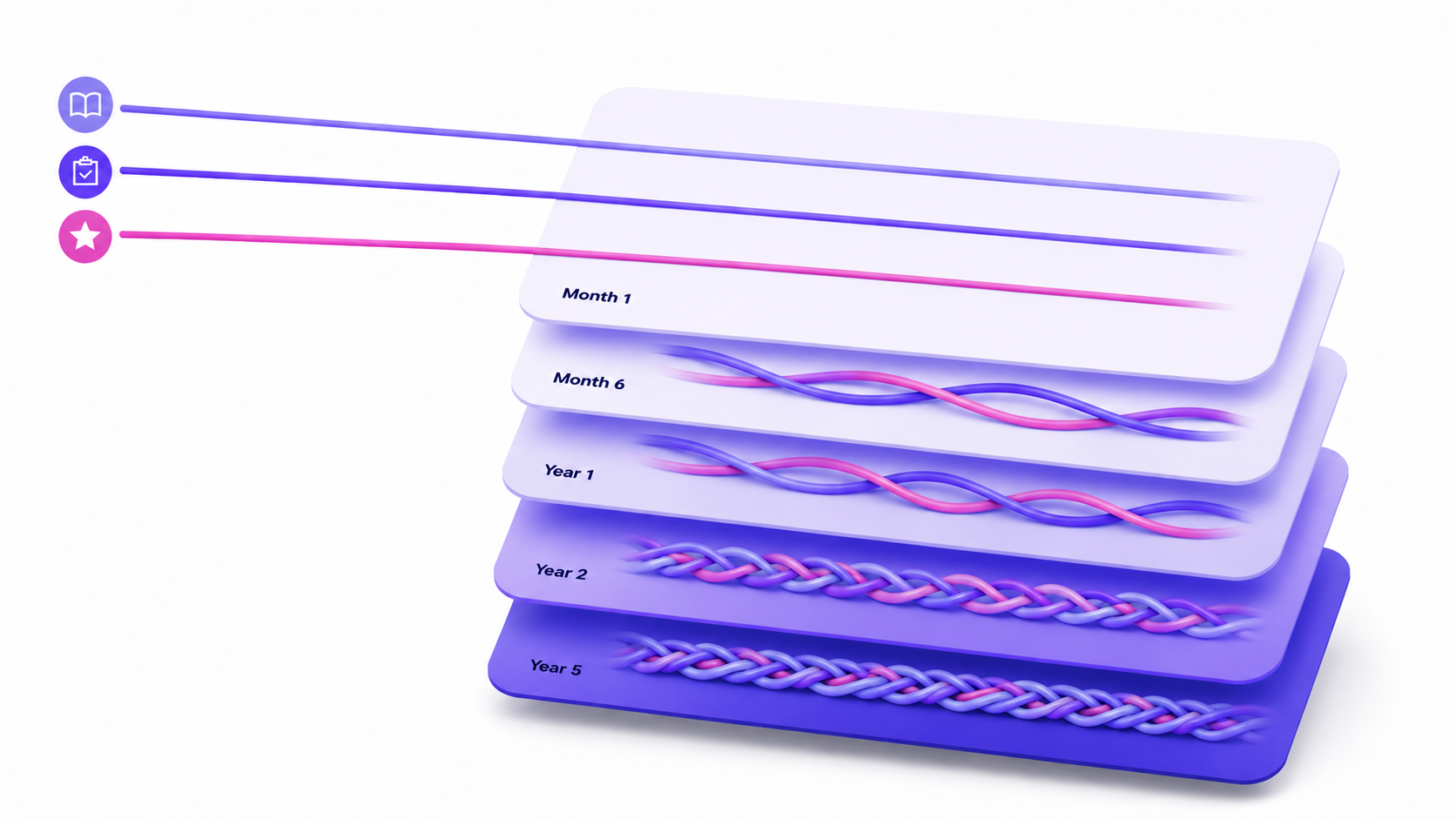
When it works, a new associate joins and their onboarding is not a sequence of handoffs (HR does the paperwork, L&D sends the training links, Ops briefs them on the floor). It is one coherent journey. Their first week has a shape to it. Learning connects directly to what they will be asked to do on the floor. Their progress is visible to the people who need to see it, without anyone having to manually compile a report.
The practical effect of this is something that sounds almost too simple to be worth saying: the associate knows what is expected of them, why it matters, and how they are doing against it. From day one.
That clarity compounds. Associates who start with it onboard faster, reach competence sooner, and stay longer. The organisations that measure this find the difference is not marginal.
Information Moves Toward the People Who Need It
In a unified frontline platform, information moves toward the people who need it, at the time they need it.
A product training module goes live. Completion data is visible to Ops in real time, not in a monthly review. The stores where completion is lagging get a nudge through the same channel the associates are already using, not a separate communication from a separate system. The associate who completes it gets a point, a badge, a signal that the effort was seen. The store manager sees their team's readiness picture in one view, not assembled from three different reports.
This sounds like a technology problem. It is partly that. But it is more fundamentally a design problem: most organisations have never explicitly decided that information should flow toward frontline employees, not just upward away from them. When they make that decision, the technology question becomes much easier to answer.
Recognition Is Built Into the Work, Not Bolted On
One of the clearest markers of an organisation that has solved this is how recognition works. Or more precisely, how it does not require anyone to remember to do it.
When it works well, recognition is structural. Completing a module earns points. Hitting a floor target earns points. A peer nominates a colleague and the system records it. The associate can see their own progress, their own balance, their own position on a leaderboard (not as a source of anxiety, but as proof that the work is being tracked and valued).
The manager's role shifts in this environment. They are not the sole source of acknowledgement. They become one voice among several, which paradoxically makes their recognition more meaningful, not less, because it is additive rather than the only signal the associate ever receives.
AI Doesn't Replace the Human Layer. It Makes It Work at Scale.
There is a version of this picture that stays at the level of good process design and better tools. That version is genuinely valuable. But the organisations that are furthest ahead have added something on top of it: intelligence that adapts to each person.
When learning, operations, and HR data exist in the same frontline workforce management platform, something becomes possible that fragmented tools simply cannot deliver. The platform starts to understand where each frontliner actually is, not just what they have completed.
An associate who is strong on product knowledge but flagging on customer handling gets a different experience from one who is confident on the floor but rusty on compliance. Content adjusts. Practice scenarios are generated from real operational context, not generic templates. A frontliner preparing for a difficult customer conversation can rehearse it before it happens, scored on understanding and approach, not just whether they said the right keywords.
This is not AI as a content generation shortcut. It is AI as the layer that makes personalisation possible at scale: the thing that used to require a great trainer to sit with every individual, now available to every frontliner regardless of which store they work in or whether their manager has the bandwidth to coach them this week.
The human layer does not disappear in this picture. Managers still coach, encourage, and develop. What changes is that they are doing it from a position of actual visibility, with time freed up from the coordination work the system is now handling.
The Three Functions Still Have Different Jobs. They Just Share a View.
HR, L&D, and Ops do not need to merge or agree on everything to make this work. What changes is not the structure, it is the shared layer underneath it: one place where the outputs of each function are visible to the others, where the frontliner receives a single coherent experience rather than three parallel ones, and where the data generated by daily work flows back to the people making decisions about training, deployment, and development.
Disagreements happen at the right level (strategy, priorities, resource allocation) rather than at the level of the frontliner, who should never have to navigate the consequences of three functions failing to coordinate.
What the Audit Question Looks Like From This Side
In organisations that have solved this, mapping a new associate's first 90 days yields a simple answer: one platform, maybe two. The associate has one place to learn, one place to check their tasks, one place to see their recognition, one place to ask a question in their own language and get an answer drawn from the organisation's actual content. Their manager has one view of where they are.
The organisation did not get there by adding a new tool to the existing stack. It got there by making a deliberate decision that the frontliner's experience of coherence was a design goal, not a side effect of having good individual functions.
That decision is the starting point. Everything else follows from it.
Where Frontlyne Fits
This is exactly why Frontlyne was built as a superapp for the frontline workforce. Not a retail training platform with some ops features added on. Not an HR tool with a learning module sitting in a corner. A single platform where learning, operations, career progression, and recognition work together, with AI layered across all of it to make the experience intelligent and personal at scale.
One place. Every frontliner. Everything they need to learn, perform, and grow.
If your organisation is still assembling that picture from separate tools, we would be glad to show you what the unified version looks like in practice.


Over the last few weeks, this blog has covered the costs that pile up when frontline processes are fragmented: missed sales, retraining cycles, attrition that compounds quietly over time.
Today, we want to talk about the flip side. What does it actually look like when HR, L&D, and Ops work as one? What does the frontliner feel when that alignment exists? And what does the organisation look like when it has deliberately built toward that?
That picture is worth spelling out carefully, because it is both more achievable and more specific than most people expect.
The Frontliner Has One Experience, Not Three
In organisations that have figured this out, the starting point is a deceptively simple design principle: the frontliner should never feel like they are being managed by three separate functions with three separate agendas.
This sounds obvious. It is surprisingly rare.
When it works, a new associate joins and their onboarding is not a sequence of handoffs (HR does the paperwork, L&D sends the training links, Ops briefs them on the floor). It is one coherent journey. Their first week has a shape to it. Learning connects directly to what they will be asked to do on the floor. Their progress is visible to the people who need to see it, without anyone having to manually compile a report.
The practical effect of this is something that sounds almost too simple to be worth saying: the associate knows what is expected of them, why it matters, and how they are doing against it. From day one.
That clarity compounds. Associates who start with it onboard faster, reach competence sooner, and stay longer. The organisations that measure this find the difference is not marginal.
Information Moves Toward the People Who Need It
In a unified frontline platform, information moves toward the people who need it, at the time they need it.
A product training module goes live. Completion data is visible to Ops in real time, not in a monthly review. The stores where completion is lagging get a nudge through the same channel the associates are already using, not a separate communication from a separate system. The associate who completes it gets a point, a badge, a signal that the effort was seen. The store manager sees their team's readiness picture in one view, not assembled from three different reports.
This sounds like a technology problem. It is partly that. But it is more fundamentally a design problem: most organisations have never explicitly decided that information should flow toward frontline employees, not just upward away from them. When they make that decision, the technology question becomes much easier to answer.
Recognition Is Built Into the Work, Not Bolted On
One of the clearest markers of an organisation that has solved this is how recognition works. Or more precisely, how it does not require anyone to remember to do it.
When it works well, recognition is structural. Completing a module earns points. Hitting a floor target earns points. A peer nominates a colleague and the system records it. The associate can see their own progress, their own balance, their own position on a leaderboard (not as a source of anxiety, but as proof that the work is being tracked and valued).
The manager's role shifts in this environment. They are not the sole source of acknowledgement. They become one voice among several, which paradoxically makes their recognition more meaningful, not less, because it is additive rather than the only signal the associate ever receives.
AI Doesn't Replace the Human Layer. It Makes It Work at Scale.
There is a version of this picture that stays at the level of good process design and better tools. That version is genuinely valuable. But the organisations that are furthest ahead have added something on top of it: intelligence that adapts to each person.
When learning, operations, and HR data exist in the same frontline workforce management platform, something becomes possible that fragmented tools simply cannot deliver. The platform starts to understand where each frontliner actually is, not just what they have completed.
An associate who is strong on product knowledge but flagging on customer handling gets a different experience from one who is confident on the floor but rusty on compliance. Content adjusts. Practice scenarios are generated from real operational context, not generic templates. A frontliner preparing for a difficult customer conversation can rehearse it before it happens, scored on understanding and approach, not just whether they said the right keywords.
This is not AI as a content generation shortcut. It is AI as the layer that makes personalisation possible at scale: the thing that used to require a great trainer to sit with every individual, now available to every frontliner regardless of which store they work in or whether their manager has the bandwidth to coach them this week.
The human layer does not disappear in this picture. Managers still coach, encourage, and develop. What changes is that they are doing it from a position of actual visibility, with time freed up from the coordination work the system is now handling.
The Three Functions Still Have Different Jobs. They Just Share a View.
HR, L&D, and Ops do not need to merge or agree on everything to make this work. What changes is not the structure, it is the shared layer underneath it: one place where the outputs of each function are visible to the others, where the frontliner receives a single coherent experience rather than three parallel ones, and where the data generated by daily work flows back to the people making decisions about training, deployment, and development.
Disagreements happen at the right level (strategy, priorities, resource allocation) rather than at the level of the frontliner, who should never have to navigate the consequences of three functions failing to coordinate.
What the Audit Question Looks Like From This Side
In organisations that have solved this, mapping a new associate's first 90 days yields a simple answer: one platform, maybe two. The associate has one place to learn, one place to check their tasks, one place to see their recognition, one place to ask a question in their own language and get an answer drawn from the organisation's actual content. Their manager has one view of where they are.
The organisation did not get there by adding a new tool to the existing stack. It got there by making a deliberate decision that the frontliner's experience of coherence was a design goal, not a side effect of having good individual functions.
That decision is the starting point. Everything else follows from it.
Where Frontlyne Fits
This is exactly why Frontlyne was built as a superapp for the frontline workforce. Not a retail training platform with some ops features added on. Not an HR tool with a learning module sitting in a corner. A single platform where learning, operations, career progression, and recognition work together, with AI layered across all of it to make the experience intelligent and personal at scale.
One place. Every frontliner. Everything they need to learn, perform, and grow.
If your organisation is still assembling that picture from separate tools, we would be glad to show you what the unified version looks like in practice.
Join the brands building better frontline workforces. Live in 50 days. No IT complexity. Dedicated support from day one.


.png)
.png)

.jpg)
.png)
.jpg)


.jpg)
.webp)


.jpg)

.jpg)

.jpg)
.png)
.png)
.png)
.png)