By
Sanjana Chavali
October 5, 2026
•
6
min read

We're heading into retail's busiest season. Festive shopping will be well underway, and footfall is only going to increase. It's also the perfect moment to ask how you keep your frontline teams engaged through the rush.
Many retailers turn to gamification (points, badges and leaderboards) to do exactly that. So if you run a frontline-powered business, there's a good chance you've seen how this plays out:
That brings us to the question - does gamification actually work in retail?
We would argue yes, when it's built around the right behaviours. The points themselves are rarely the problem. What matters is what earns them, how fairly they're given, and whether people still have a reason to come back eight weeks after launch. This guide covers how to set that system up so it keeps working well after the first few weeks.
For the case for recognition itself, see our earlier piece on frontline employee retention.
Each mechanic has its own strength. The best programmes use each one for the job it suits.
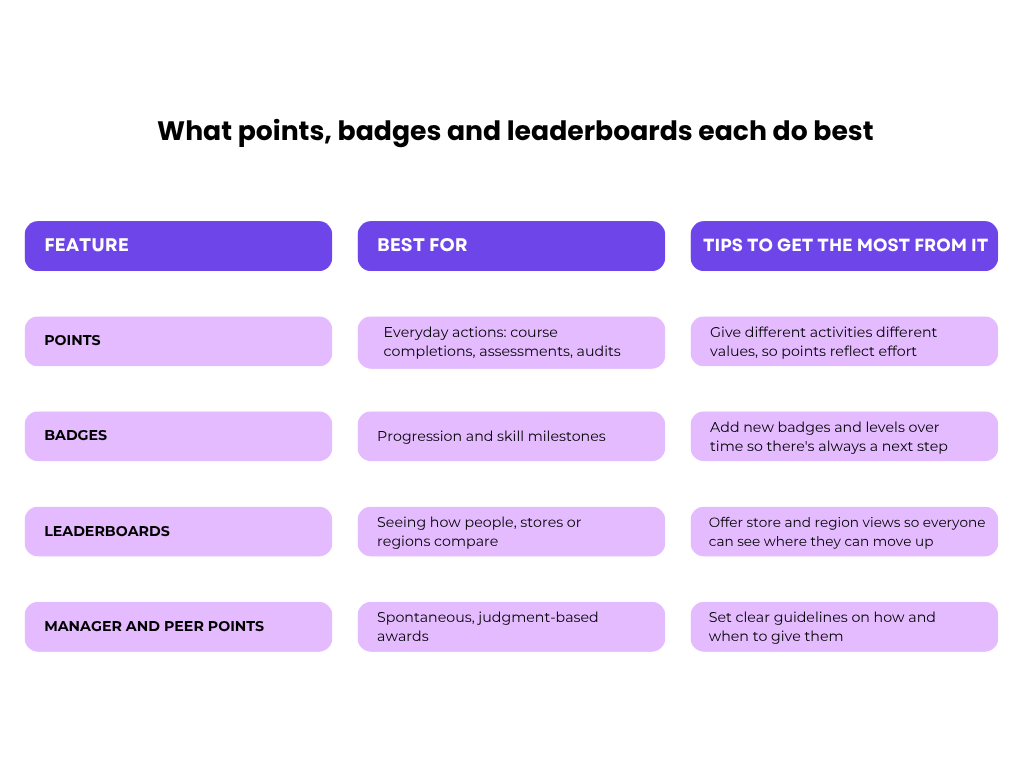
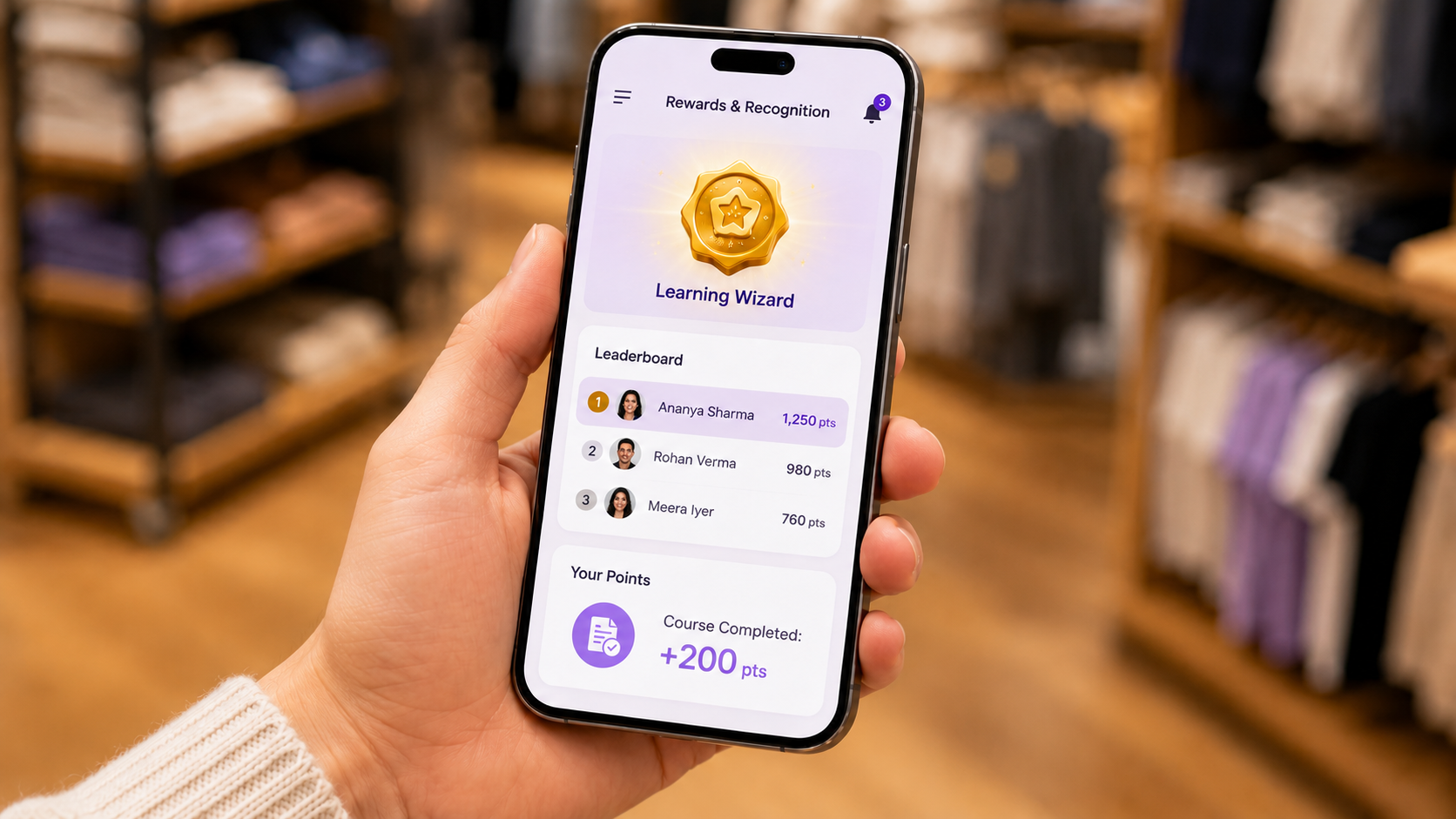
With Frontlyne, points can be earned for course completions, assessments, training attendance, audit completion and skill achievements. Badges mark learning milestones and training achievements. Leaderboards run at store, region, organisation and brand level, and managers and peers can award points directly.
The most important decision in any points system is what earns points, and how many. A clear point plan is what can turn a retail LMS from a place people visit into a habit they want to keep.
Activity points follow rules: finish the course, get the points. Manager and peer points follow judgment, so a little structure helps them work well. Here are some practices to consider:
Automatic points keep the system fair and consistent, while manager and peer points let you recognise things no activity rule can capture. Many teams start with manager and peer points as a small share of the total and adjust from there. In a busy week, they're also a quick way to say thank you in the moment.
A good programme is one people trust. Here are three things to put in place from day one.
Set a pass mark and a sensible retake limit. So points reflect real product knowledge.
Keep comparisons fair. A busy flagship and a quiet outlet don't get the same number of customers, so they shouldn't be judged on the same sales number. Set each store's target based on its own footfall and size, or compare stores with their own last month. That way, every team has a real shot at the top.
Set team goals when people share customers. When colleagues serve the same customers, team goals keep everyone pulling in the same direction. Individual points work well for things people fully control, like learning and audits.
Store, region, organisation and brand leaderboards answer different questions. For most associates, the store board is the one that matters, because the gap to the next position is small enough to close in a few weeks, with the region board as the next goal. Managers get more from the region board, and head office from the organisation and brand views.
Look beyond total points issued. These measures show the real impact:
Watch for high participation with flat scores, a few people dominating the leaderboard, or peer points concentrated in small groups. Each is a cue to adjust point values or rules.
The best question isn't "does gamification work?" but what behaviour do we want to encourage, and which mechanic suits it?
Match each to the right job, then review and refine.
If you'd like to see how this works in practice, Frontlyne brings custom point plans, learning badges, multi-level leaderboards, and manager and peer points together in one connected frontline productivity platform. Book a demo to see it in action.


We're heading into retail's busiest season. Festive shopping will be well underway, and footfall is only going to increase. It's also the perfect moment to ask how you keep your frontline teams engaged through the rush.
Many retailers turn to gamification (points, badges and leaderboards) to do exactly that. So if you run a frontline-powered business, there's a good chance you've seen how this plays out:
That brings us to the question - does gamification actually work in retail?
We would argue yes, when it's built around the right behaviours. The points themselves are rarely the problem. What matters is what earns them, how fairly they're given, and whether people still have a reason to come back eight weeks after launch. This guide covers how to set that system up so it keeps working well after the first few weeks.
For the case for recognition itself, see our earlier piece on frontline employee retention.
Each mechanic has its own strength. The best programmes use each one for the job it suits.
With Frontlyne, points can be earned for course completions, assessments, training attendance, audit completion and skill achievements. Badges mark learning milestones and training achievements. Leaderboards run at store, region, organisation and brand level, and managers and peers can award points directly.
The most important decision in any points system is what earns points, and how many. A clear point plan is what can turn a retail LMS from a place people visit into a habit they want to keep.
Activity points follow rules: finish the course, get the points. Manager and peer points follow judgment, so a little structure helps them work well. Here are some practices to consider:
Automatic points keep the system fair and consistent, while manager and peer points let you recognise things no activity rule can capture. Many teams start with manager and peer points as a small share of the total and adjust from there. In a busy week, they're also a quick way to say thank you in the moment.
A good programme is one people trust. Here are three things to put in place from day one.
Set a pass mark and a sensible retake limit. So points reflect real product knowledge.
Keep comparisons fair. A busy flagship and a quiet outlet don't get the same number of customers, so they shouldn't be judged on the same sales number. Set each store's target based on its own footfall and size, or compare stores with their own last month. That way, every team has a real shot at the top.
Set team goals when people share customers. When colleagues serve the same customers, team goals keep everyone pulling in the same direction. Individual points work well for things people fully control, like learning and audits.
Store, region, organisation and brand leaderboards answer different questions. For most associates, the store board is the one that matters, because the gap to the next position is small enough to close in a few weeks, with the region board as the next goal. Managers get more from the region board, and head office from the organisation and brand views.
Look beyond total points issued. These measures show the real impact:
Watch for high participation with flat scores, a few people dominating the leaderboard, or peer points concentrated in small groups. Each is a cue to adjust point values or rules.
The best question isn't "does gamification work?" but what behaviour do we want to encourage, and which mechanic suits it?
Match each to the right job, then review and refine.
If you'd like to see how this works in practice, Frontlyne brings custom point plans, learning badges, multi-level leaderboards, and manager and peer points together in one connected frontline productivity platform. Book a demo to see it in action.
Join the brands building better frontline workforces. Live in 50 days. No IT complexity. Dedicated support from day one.


.png)
.jpg)
.png)
.png)