By
Sanjana Chavali
October 8, 2026
•
7
min read

Picture a customer who walks out of two stores on the same afternoon.
The first was fine. By the time they reach the parking lot, they have forgotten its exact name. The second one, they remember, and they go back the following week.
Neither store had a bigger budget or a famous face on the posters. So what exactly brings people back to a store?
Ask a shopper why they return somewhere and they will rarely mention training, processes, or standards. They will say:
These reasons fall into three groups: good quality, good customer experience, and a good ambience. Customers feel these things, but no one can instruct a shopper to feel that way. They are outcomes, produced by what the frontline does, across each shift.
Each feeling traces back to something that went right operationally, and each of those to something the frontline was equipped to do.
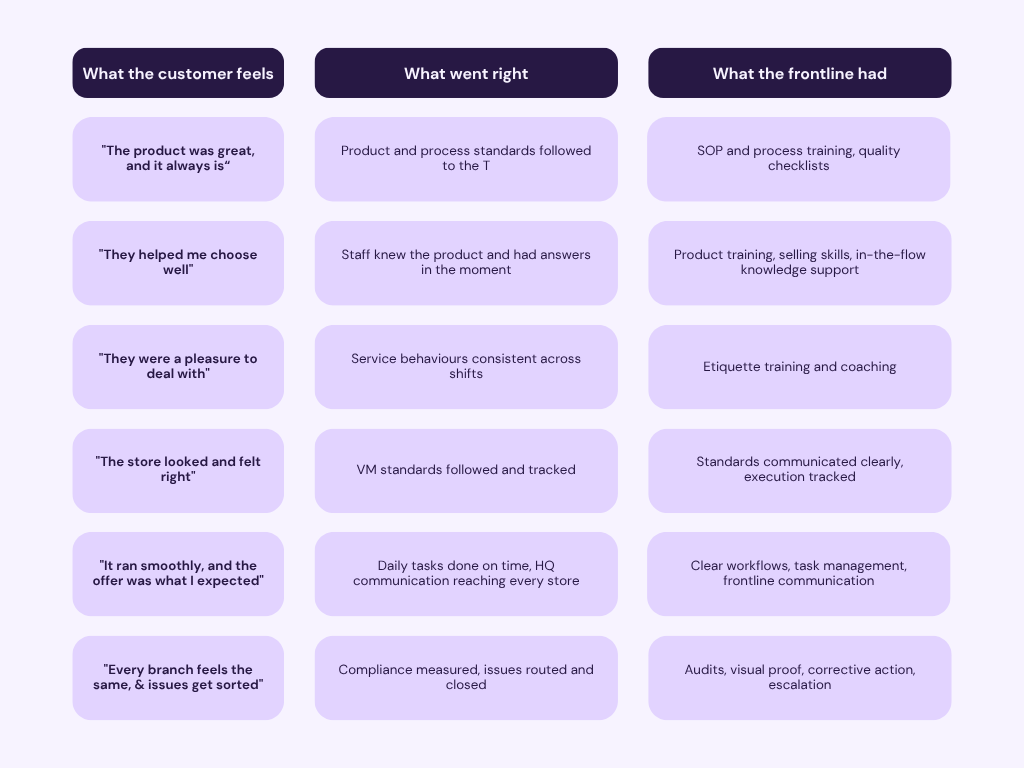
Let's walk through each row.
This is where repeat purchase begins. If the product disappoints, nothing else matters. A great greeting cannot rescue a lukewarm burger.
In a quick-service restaurant, quality is made in the preparation: the right recipe, the right portion, the right temperature, the right assembly, the same coffee at 8 AM and at 8 PM. In other retail formats it shows up as fresh stock, intact packaging, expiry dates checked, and products handled the way the brand intended.
Quality is rarely about talent. It comes from standards followed to the last detail, by everyone, on every shift. The stores that get this right have people who were trained on the standard, given a checklist that fits the work, and shown what "right" looks like.
Trust builds when a customer asks which of two products suits her and the associate answers honestly and confidently. Behind that moment are product training that stuck, selling skills that were practised, and quick access to the right answer when it was needed.
Service is made of small behaviours: the greeting, the approach, an efficient return, a warm goodbye. Each is simple, and the skill is doing them for every customer, on a Tuesday morning and a packed Saturday evening. That comes from etiquette training that continues past onboarding, and coaching that tells people how they are really doing.
Good ambience doesn't happen by accident. It is the right display up on launch day, stock in its place, clean fixtures, signage and lighting as designed. The best stores treat visual merchandising standards as a daily practice: clearly communicated, carefully executed, and tracked so that great execution gets noticed.
A store that simply runs well feels good to shop in: shelves replenished, counters ready, queues moving smoothly, and the month's promotion known to everyone behind the counter. That takes tasks completed on time and HQ communication that reaches every store at the same moment, in an actionable way for frontliners.
Repeat customers return to a brand, not just a store. Consistency across locations comes from measuring against the standard, seeing execution with evidence, and routing any issue to someone who closes it. When that happens, customers learn they can count on the brand wherever they are.
Look at the table again and every row has the same shape. Someone knew what good looks like. They did it. And it was checked, so the next shift could repeat it.
That is why a great experience is rarely the product of one training programme. It is hundreds of frontline actions going right, across every shift, employee, and store.
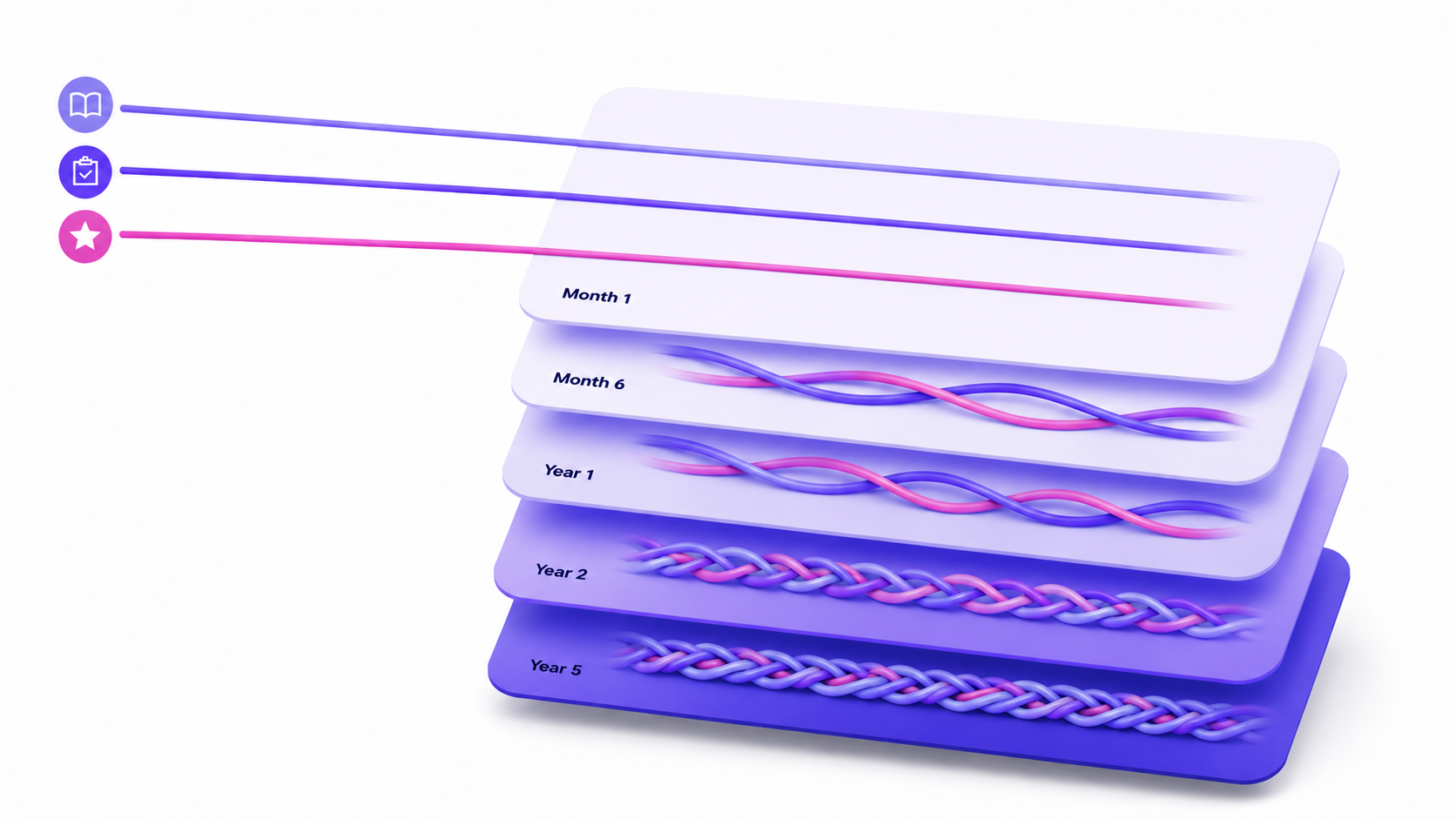
Treat the third column as a list now: training, coaching, answers on demand, communication, tasks, audits, issue handling. A great store needs every one of these, and they have to work together rather than as separate programmes.
Picture a restaurant chain launching a new seasonal menu item. An associate opens the app and does a two-minute lesson on the recipe. She is given a task to prepare the first one to specification, and she uploads a photo when it's done. Her manager sees the photo and gives feedback in that same shift. She earns a bit of recognition for getting it right. HQ can see which stores nailed the launch and share what they did with the rest.
Nobody had to chase anyone. She learned it, did it, and heard how she performed within the same day, because the lesson, the task, the feedback, and the recognition all lived in one place. That is what a connected app does: what the frontline learns becomes what the customer experiences.
Strip away the tools and the terminology, and the idea is simple. Customers come back to stores where the people on the floor know what good looks like and have what they need to deliver it. The store they return to is rarely the one with the grandest strategy. It is the one where thousands of small things go right, again and again.
That is why we built Frontlyne as a frontline superapp: learning, operations, communication, and recognition in one place, so every frontliner is set up to do their best work, and every customer has a reason to come back.
If you would like to see what that looks like in a real store or restaurant, we would be glad to show you.


Picture a customer who walks out of two stores on the same afternoon.
The first was fine. By the time they reach the parking lot, they have forgotten its exact name. The second one, they remember, and they go back the following week.
Neither store had a bigger budget or a famous face on the posters. So what exactly brings people back to a store?
Ask a shopper why they return somewhere and they will rarely mention training, processes, or standards. They will say:
These reasons fall into three groups: good quality, good customer experience, and a good ambience. Customers feel these things, but no one can instruct a shopper to feel that way. They are outcomes, produced by what the frontline does, across each shift.
Each feeling traces back to something that went right operationally, and each of those to something the frontline was equipped to do.
Let's walk through each row.
This is where repeat purchase begins. If the product disappoints, nothing else matters. A great greeting cannot rescue a lukewarm burger.
In a quick-service restaurant, quality is made in the preparation: the right recipe, the right portion, the right temperature, the right assembly, the same coffee at 8 AM and at 8 PM. In other retail formats it shows up as fresh stock, intact packaging, expiry dates checked, and products handled the way the brand intended.
Quality is rarely about talent. It comes from standards followed to the last detail, by everyone, on every shift. The stores that get this right have people who were trained on the standard, given a checklist that fits the work, and shown what "right" looks like.
Trust builds when a customer asks which of two products suits her and the associate answers honestly and confidently. Behind that moment are product training that stuck, selling skills that were practised, and quick access to the right answer when it was needed.
Service is made of small behaviours: the greeting, the approach, an efficient return, a warm goodbye. Each is simple, and the skill is doing them for every customer, on a Tuesday morning and a packed Saturday evening. That comes from etiquette training that continues past onboarding, and coaching that tells people how they are really doing.
Good ambience doesn't happen by accident. It is the right display up on launch day, stock in its place, clean fixtures, signage and lighting as designed. The best stores treat visual merchandising standards as a daily practice: clearly communicated, carefully executed, and tracked so that great execution gets noticed.
A store that simply runs well feels good to shop in: shelves replenished, counters ready, queues moving smoothly, and the month's promotion known to everyone behind the counter. That takes tasks completed on time and HQ communication that reaches every store at the same moment, in an actionable way for frontliners.
Repeat customers return to a brand, not just a store. Consistency across locations comes from measuring against the standard, seeing execution with evidence, and routing any issue to someone who closes it. When that happens, customers learn they can count on the brand wherever they are.
Look at the table again and every row has the same shape. Someone knew what good looks like. They did it. And it was checked, so the next shift could repeat it.
That is why a great experience is rarely the product of one training programme. It is hundreds of frontline actions going right, across every shift, employee, and store.
Treat the third column as a list now: training, coaching, answers on demand, communication, tasks, audits, issue handling. A great store needs every one of these, and they have to work together rather than as separate programmes.
Picture a restaurant chain launching a new seasonal menu item. An associate opens the app and does a two-minute lesson on the recipe. She is given a task to prepare the first one to specification, and she uploads a photo when it's done. Her manager sees the photo and gives feedback in that same shift. She earns a bit of recognition for getting it right. HQ can see which stores nailed the launch and share what they did with the rest.
Nobody had to chase anyone. She learned it, did it, and heard how she performed within the same day, because the lesson, the task, the feedback, and the recognition all lived in one place. That is what a connected app does: what the frontline learns becomes what the customer experiences.
Strip away the tools and the terminology, and the idea is simple. Customers come back to stores where the people on the floor know what good looks like and have what they need to deliver it. The store they return to is rarely the one with the grandest strategy. It is the one where thousands of small things go right, again and again.
That is why we built Frontlyne as a frontline superapp: learning, operations, communication, and recognition in one place, so every frontliner is set up to do their best work, and every customer has a reason to come back.
If you would like to see what that looks like in a real store or restaurant, we would be glad to show you.
Join the brands building better frontline workforces. Live in 50 days. No IT complexity. Dedicated support from day one.


.png)
.png)


.jpg)
.png)
.jpg)


.jpg)
.webp)


.jpg)

.jpg)



.png)
.jpg)