By
Sanjana Chavali
October 21, 2026
•
min read

A festive campaign can involve dozens of stores, hundreds of employees, and a long list of activities that need to come together before launch day.
A retail store readiness checklist helps operations teams organise these activities, coordinate employees, verify merchandising requirements, and track preparation across locations.
We've experienced festive retail from both sides: as customers shopping during busy periods and as a team building software for the people who keep stores running. This has given us an appreciation for the coordination involved in a successful festive rollout.
In our earlier article, More Customers, More Informed Customers: How To Prepare for the Festive Season This Year, we explored how retailers can prepare employees for festive customer conversations. This time, we're focusing on the operational work that brings those campaigns to life.
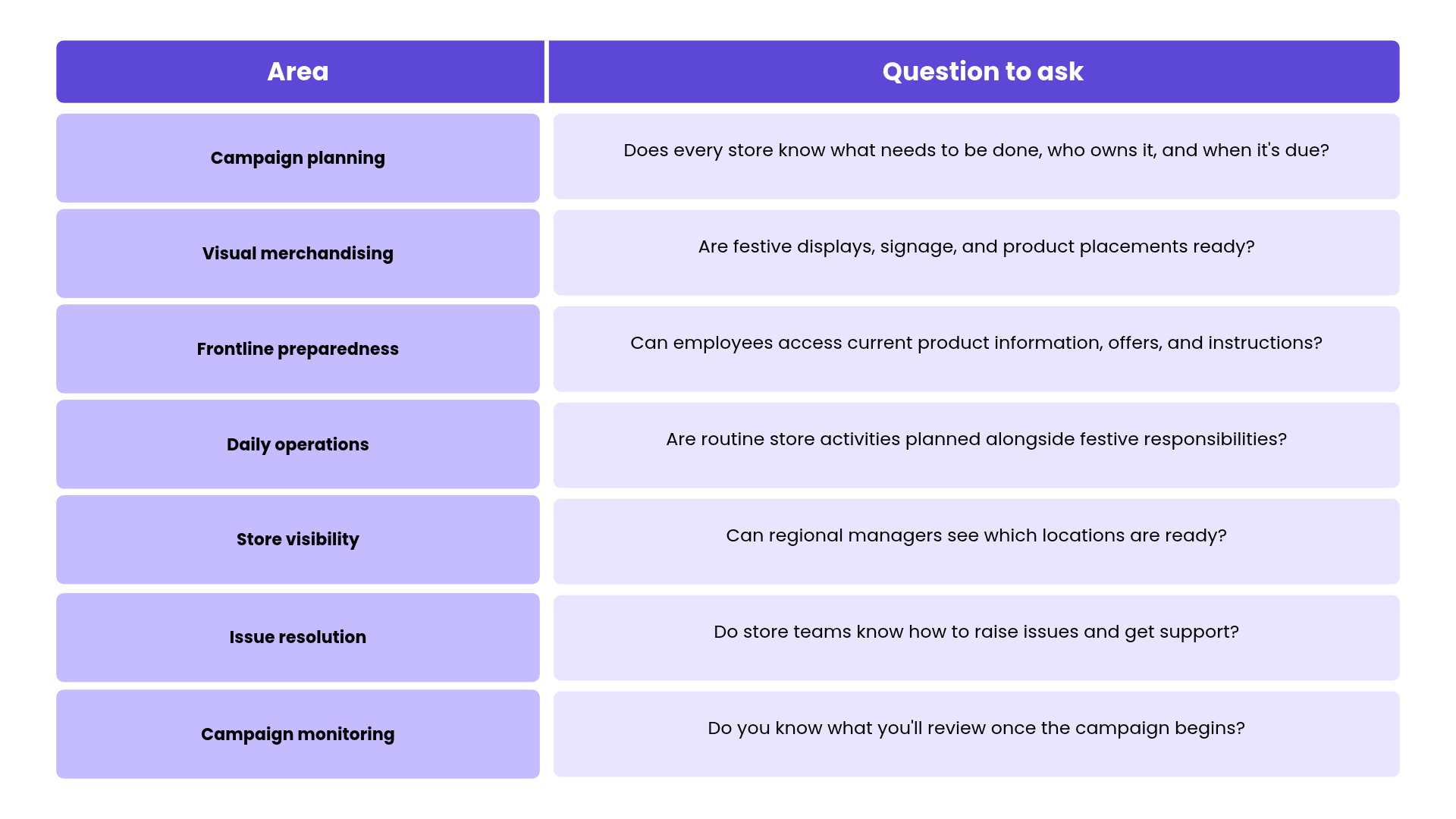
Let's run through a festive season readiness check.
Whether you're responsible for one store, a region, or a nationwide retail network, here are seven questions worth asking before your campaign goes live. We'll start with a quick overview, then explore each area in more detail.
A campaign plan becomes useful to store teams when it's translated into clear activities with owners and deadlines.
Marketing may have finalised the campaign, merchandising may have shared display guidelines, and operations may have established the rollout timeline. Each store now needs to know what to do and when.
A simple festive campaign rollout plan could look like this:
The important part is translating this plan into clear responsibilities for each store. Teams should know what's expected at every stage, who to approach for support, and which activities need to be completed before the campaign can move forward.
Readiness check: Does every store have a clear list of campaign activities, assigned owners, and completion dates?
Festive displays, promotional signage, lighting, and product arrangements help bring a campaign to life inside the store.
For multi-location retailers, a consistent merchandising checklist helps teams follow the same campaign requirements while accommodating different store layouts.
Before launch, check that:
Store managers can review these requirements locally, while regional teams can use completed checks and photographs to understand how displays have been implemented across locations.
Readiness check: Have your stores completed their festive merchandising requirements, and can managers verify that the displays are ready?
Festive campaigns often introduce new collections, product bundles, special offers, and seasonal promotions.
A customer shopping for gifts might ask an associate to compare products, explain an offer, or recommend an alternative. Having accurate information close at hand helps employees handle these conversations confidently.
Before the campaign begins, make sure frontline teams can access:
Briefings can introduce the campaign, while accessible reference information helps employees revisit details as needed. This is particularly useful for newly onboarded or temporary festive staff.
Readiness check: Can every employee find the information they need to support customers during the festive season?
Festive activities happen alongside the everyday work of running a store.
Opening routines, replenishment, housekeeping, maintenance, and closing checks all continue, often while teams are managing additional campaign responsibilities.
A daily plan helps managers organise this work around customer traffic and store priorities.
For example, a store manager preparing for a busy festive shopping day might organise responsibilities around three stages:
Giving employees a clear view of their responsibilities helps teams coordinate their shifts. We explored this further in How a Clear View of the Day Improves Productivity.
Readiness check: Have you planned festive campaign activities alongside the regular tasks that keep your stores running?
Imagine a retail brand preparing to launch its Diwali campaign across 80 stores.
Each location is completing its preparation activities, while regional managers need to understand how the rollout is progressing.
A useful readiness view should answer a few straightforward questions:
For retail operations teams, task completion records can help establish which activities have been carried out, while store checklists and audit findings provide additional context about readiness. Together, these inputs help regional managers understand where follow-up may be needed.
Readiness check: Can your regional team quickly identify which stores are ready and which activities still need follow-up?
A store might need replacement signage, clarification about an offer, or help with a display fixture. These requests are a normal part of coordinating campaigns across locations.
What matters is having a clear process for addressing them.
When a store raises a requirement, the team should be able to establish:
This helps store managers and regional teams coordinate support and keep track of outstanding activities.
Readiness check: Do employees know how to raise campaign-related issues, who owns the follow-up, and how resolution will be confirmed?
Once the campaign begins, regular operational reviews help teams maintain consistency across stores.
Regional managers can monitor recurring merchandising checks, campaign tasks, replenishment activities, and outstanding issues.
Some useful questions include:
These reviews can also inform future campaigns. If a particular merchandising activity consistently takes longer than planned, for example, teams can adjust the rollout timeline next time.
Readiness check: Have you identified which activities you'll monitor during the campaign and what you'll review afterwards?
Festive readiness brings together campaign planning, task management, employee knowledge, checklists, audits, and operational visibility.
At Frontlyne, we've brought Knowledge, Execution, and Intelligence together in one app to help frontline employees access relevant information, manage their responsibilities, and give managers better visibility into work across locations.
The aim is to make everyday retail operations easier to coordinate, whether teams are preparing for a festive campaign or managing the regular demands of running stores.
Every retail network prepares for the festive season a little differently. Here are a few practical questions to consider as you plan your rollout.
Start with the campaign's launch date and work backwards to identify key preparation milestones. Group activities under merchandising, employee readiness, daily operations and store checks. For each activity, specify the responsible team, deadline and how readiness will be confirmed. This turns a general checklist into a practical preparation plan for each store.
Common challenges include stores receiving campaign updates at different times, variations in merchandising setup, last-minute promotional changes and limited time for employee briefings. Retailers can reduce these gaps by establishing common guidelines, communicating changes clearly and allowing time to resolve store-specific requirements before launch.
The key is planning around increased customer traffic rather than treating every day like a regular trading day. Stores can schedule replenishment and display maintenance around quieter periods, keep essential opening and closing routines consistent, and review staffing priorities as footfall changes. This helps teams maintain everyday standards while handling festive demand.
A successful festive rollout depends on many teams working together, from marketing and merchandising to store employees and regional operations.
These seven readiness checks offer a practical starting point for coordinating that work, reviewing progress, and preparing stores for the campaign ahead.
At Frontlyne, our goal is to help turn every frontline employee into a better operator by connecting the knowledge they need, the work they do, and the visibility that helps teams keep improving.
Want to see how Frontlyne can support your retail teams this festive season?


A festive campaign can involve dozens of stores, hundreds of employees, and a long list of activities that need to come together before launch day.
A retail store readiness checklist helps operations teams organise these activities, coordinate employees, verify merchandising requirements, and track preparation across locations.
We've experienced festive retail from both sides: as customers shopping during busy periods and as a team building software for the people who keep stores running. This has given us an appreciation for the coordination involved in a successful festive rollout.
In our earlier article, More Customers, More Informed Customers: How To Prepare for the Festive Season This Year, we explored how retailers can prepare employees for festive customer conversations. This time, we're focusing on the operational work that brings those campaigns to life.
Let's run through a festive season readiness check.
Whether you're responsible for one store, a region, or a nationwide retail network, here are seven questions worth asking before your campaign goes live. We'll start with a quick overview, then explore each area in more detail.
A campaign plan becomes useful to store teams when it's translated into clear activities with owners and deadlines.
Marketing may have finalised the campaign, merchandising may have shared display guidelines, and operations may have established the rollout timeline. Each store now needs to know what to do and when.
A simple festive campaign rollout plan could look like this:
The important part is translating this plan into clear responsibilities for each store. Teams should know what's expected at every stage, who to approach for support, and which activities need to be completed before the campaign can move forward.
Readiness check: Does every store have a clear list of campaign activities, assigned owners, and completion dates?
Festive displays, promotional signage, lighting, and product arrangements help bring a campaign to life inside the store.
For multi-location retailers, a consistent merchandising checklist helps teams follow the same campaign requirements while accommodating different store layouts.
Before launch, check that:
Store managers can review these requirements locally, while regional teams can use completed checks and photographs to understand how displays have been implemented across locations.
Readiness check: Have your stores completed their festive merchandising requirements, and can managers verify that the displays are ready?
Festive campaigns often introduce new collections, product bundles, special offers, and seasonal promotions.
A customer shopping for gifts might ask an associate to compare products, explain an offer, or recommend an alternative. Having accurate information close at hand helps employees handle these conversations confidently.
Before the campaign begins, make sure frontline teams can access:
Briefings can introduce the campaign, while accessible reference information helps employees revisit details as needed. This is particularly useful for newly onboarded or temporary festive staff.
Readiness check: Can every employee find the information they need to support customers during the festive season?
Festive activities happen alongside the everyday work of running a store.
Opening routines, replenishment, housekeeping, maintenance, and closing checks all continue, often while teams are managing additional campaign responsibilities.
A daily plan helps managers organise this work around customer traffic and store priorities.
For example, a store manager preparing for a busy festive shopping day might organise responsibilities around three stages:
Giving employees a clear view of their responsibilities helps teams coordinate their shifts. We explored this further in How a Clear View of the Day Improves Productivity.
Readiness check: Have you planned festive campaign activities alongside the regular tasks that keep your stores running?
Imagine a retail brand preparing to launch its Diwali campaign across 80 stores.
Each location is completing its preparation activities, while regional managers need to understand how the rollout is progressing.
A useful readiness view should answer a few straightforward questions:
For retail operations teams, task completion records can help establish which activities have been carried out, while store checklists and audit findings provide additional context about readiness. Together, these inputs help regional managers understand where follow-up may be needed.
Readiness check: Can your regional team quickly identify which stores are ready and which activities still need follow-up?
A store might need replacement signage, clarification about an offer, or help with a display fixture. These requests are a normal part of coordinating campaigns across locations.
What matters is having a clear process for addressing them.
When a store raises a requirement, the team should be able to establish:
This helps store managers and regional teams coordinate support and keep track of outstanding activities.
Readiness check: Do employees know how to raise campaign-related issues, who owns the follow-up, and how resolution will be confirmed?
Once the campaign begins, regular operational reviews help teams maintain consistency across stores.
Regional managers can monitor recurring merchandising checks, campaign tasks, replenishment activities, and outstanding issues.
Some useful questions include:
These reviews can also inform future campaigns. If a particular merchandising activity consistently takes longer than planned, for example, teams can adjust the rollout timeline next time.
Readiness check: Have you identified which activities you'll monitor during the campaign and what you'll review afterwards?
Festive readiness brings together campaign planning, task management, employee knowledge, checklists, audits, and operational visibility.
At Frontlyne, we've brought Knowledge, Execution, and Intelligence together in one app to help frontline employees access relevant information, manage their responsibilities, and give managers better visibility into work across locations.
The aim is to make everyday retail operations easier to coordinate, whether teams are preparing for a festive campaign or managing the regular demands of running stores.
Every retail network prepares for the festive season a little differently. Here are a few practical questions to consider as you plan your rollout.
Start with the campaign's launch date and work backwards to identify key preparation milestones. Group activities under merchandising, employee readiness, daily operations and store checks. For each activity, specify the responsible team, deadline and how readiness will be confirmed. This turns a general checklist into a practical preparation plan for each store.
Common challenges include stores receiving campaign updates at different times, variations in merchandising setup, last-minute promotional changes and limited time for employee briefings. Retailers can reduce these gaps by establishing common guidelines, communicating changes clearly and allowing time to resolve store-specific requirements before launch.
The key is planning around increased customer traffic rather than treating every day like a regular trading day. Stores can schedule replenishment and display maintenance around quieter periods, keep essential opening and closing routines consistent, and review staffing priorities as footfall changes. This helps teams maintain everyday standards while handling festive demand.
A successful festive rollout depends on many teams working together, from marketing and merchandising to store employees and regional operations.
These seven readiness checks offer a practical starting point for coordinating that work, reviewing progress, and preparing stores for the campaign ahead.
At Frontlyne, our goal is to help turn every frontline employee into a better operator by connecting the knowledge they need, the work they do, and the visibility that helps teams keep improving.
Want to see how Frontlyne can support your retail teams this festive season?
Join the brands building better frontline workforces. Live in 50 days. No IT complexity. Dedicated support from day one.