By
Sanjana Chavali
September 16, 2026
•
8
min read
.png)
Peak festive season. You're expecting good footfall, and naturally, good sales numbers.
But here’s the catch - some of your buyers already know exactly what they want.
Some might have bookmarked trends on Instagram, browsed Pinterest and Reddit, or consulted an AI chatbot before they've even walked in. Others are still figuring it out. In effect, the buying journey today often begins way before a customer even sets foot in a store.
So, when that customer walks in, can your salesperson gauge what stage of the buying process they're actually interacting with?
Because the real challenge of the festive season isn't just that there will be more customers; it's that there will be more kinds of conversations to handle.
Let's set the stage: when the festive rush hits, three things happen at once:
Put those three together, and the spectrum of customer conversations widens. You'll have browsers who genuinely want assistance, and you'll have shoppers who've boiled it down to two or three options and just need help choosing the right one.
The typical way of selling (confused customer, need discovery, product suggestion) might not automatically apply anymore.
Here's an interesting distinction: it's not that knowledgeable customers make a salesperson less important. It's that the equation changes - i.e.what they need from the salesperson evolves.
Some want reassurance, while some want simplification, some want expertise, and some just want a clear recommendation.
But before a salesperson can offer any of that, there's a skill that comes first: identifying where the customer already is. Before they recommend, validate, simplify or upsell, salespeople need to answer a simpler question: where is this customer in their buying journey, and what do they need from me right now?
Consider three customers walking into a department store this festive season.
They've already done their homework. They've seen a design on Instagram, Pinterest or YouTube, and narrowed their choice to two or three pieces of jewellery. They're in the store to see how the stones actually catch the light, check the weight and finish, and make sure the online research translates to reality.
What they need is confidence, not another product presentation. The salesperson's job is to understand what they've shortlisted and identify the uncertainty that remains.
Instead of "let me show you everything we have," it's "what are you deciding between?" Then help them resolve that decision.
This requires the salesperson to resist the instinct to over-sell: can they quickly identify an informed customer and move into validation rather than restarting discovery from scratch?
Identify → validate.
They've researched too much: saved 20 links, multiple reviews, different opinions, several recommendations, maybe even an AI-generated comparison of the latest laptops. They don't need more information; they need less.
Here, the salesperson becomes an editor. They ask the right questions, filter the options, and connect the recommendation to the customer's actual occasion or need. For example: "if you mainly need this for gifting and streaming, not gaming, I'd narrow it down to these two models."
Now, the salesperson isn't dumping information; they're reducing cognitive load.
This means the salesperson needs to know how to simplify without being dismissive: can they identify what actually matters to this customer, narrow down choices confidently, and recommend without burying them under five more options?
Identify → simplify.
They've already consulted AI, and might even arrive with a specific recommendation ("ChatGPT told me this is the best option for me").
But they still came to the store. Why? Because there's a gap between information and experience.
They want to know: does this silhouette actually suit them, does the fabric feel right, is the colour what it looks like online, does this work for the occasion, and is there something the AI doesn't know about their particular situation?
What they need is human context. The salesperson doesn't need to "beat AI"; they need to add what AI can't get from a generic prompt: knowledge of the customer standing in front of them, the product in front of them, and the context of the purchase.
This means the salesperson needs experience engaging with an informed customer without becoming defensive about the information they've brought in. The response isn't "AI doesn't know anything about this." It's closer to: "that choice works well for everyday wear, which is probably why it came up. But given you mentioned you'll wear this mostly for weddings and events, I'd point you toward something with a bit more presence."
Identify → contextualise.
These three aren't fixed types of customers; they're points on a spectrum. A real customer might sit between two of them, or move from one to another mid-conversation. What matters isn't which label fits, it's whether the salesperson can identify where the customer currently stands and respond to that.
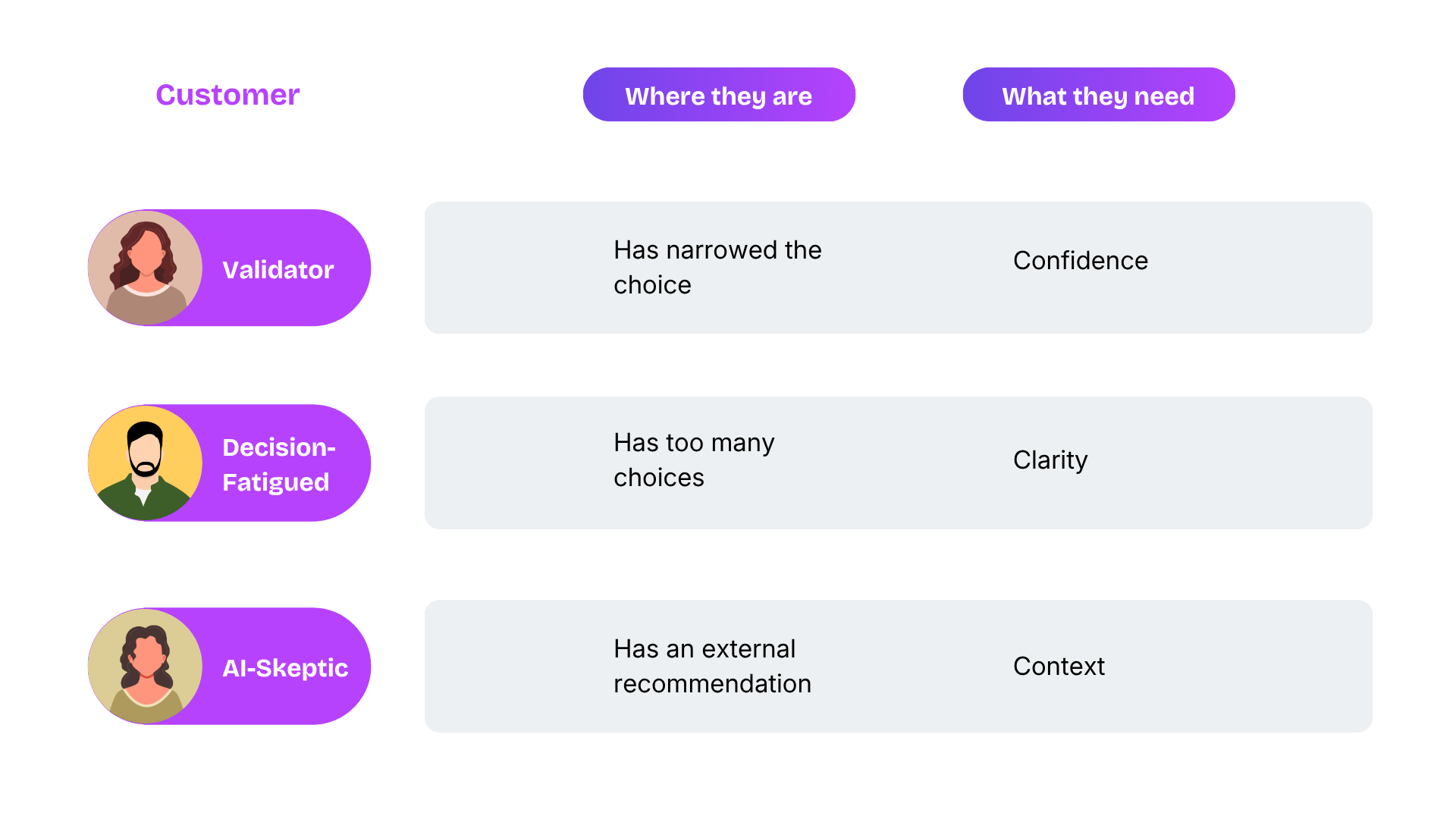
The salesperson can't assume every customer needs discovery. Some do; some need validation instead, some need simplification, and some just need someone to add what a screen can't: context that is specific to them.
This is where the traditional approach to selling needs to evolve:
Traditional: Discover → Recommend → Close
Evolved: Identify → Understand → Respond → Recommend → Close
Identifying where the customer stands is the step that decides everything after it. If they skip it, even a well-timed cross-sell or upsell would feel like a pitch instead of a suggestion; and if they get it right, expanding the sale becomes a natural extension of the conversation rather than a separate step.
The old sequence still holds up well when the customer actually needs discovery; it just isn't the only sequence anymore.
Now that your customers are arriving at different stages, are your salespeople equipped to handle each of those situations?
Traditional product training can tell someone what the product does, what it costs, what the offer is, its features, and its USPs. But that doesn't necessarily teach them:
Knowing the product is one skill. Knowing what to do with that knowledge in a customer conversation is another.
You can't wait for the festive rush to discover which conversations your frontline struggles with. And realistically, you can't have managers roleplay every scenario with every salesperson, repeatedly, across every store.
So, what if frontline teams could work through these conversations before the customer walks in, with a Validator who wants reassurance, a Decision-Fatigued customer who wants the choice narrowed, and an AI-Skeptic who challenges the recommendation with something they've already been told?
That's practice a manager can't realistically deliver at this scale, but it's exactly what these conversations need: not another module on product features, but repeated chances to work through the conversation itself. The objective isn't to teach salespeople how to talk to AI; it's to give them more opportunities to practise talking to customers.
This festive season, more customers may walk through your doors than usual. But they all won't walk in looking for the same thing.
The frontline challenge isn't simply knowing more about the products; it's knowing what the customer needs from them in that moment. And that's something teams need an opportunity to practise.
The question for retailers, then, isn't whether their frontline needs training. It's whether they're training for the conversations their customers are actually having.
We believe that knowledge is most valuable when it can be applied to various contexts. That's why we built our Roleplay engine: to let frontliners practise, respond, get feedback, and try again, so they can meet customers exactly where they are, whether that's a Validator who needs confidence, a Decision-Fatigued shopper who needs clarity, or an AI-Skeptic who needs context.
At Frontlyne, AI Roleplays give frontline teams a way to practise those conversations before they happen on the shop floor.


Peak festive season. You're expecting good footfall, and naturally, good sales numbers.
But here’s the catch - some of your buyers already know exactly what they want.
Some might have bookmarked trends on Instagram, browsed Pinterest and Reddit, or consulted an AI chatbot before they've even walked in. Others are still figuring it out. In effect, the buying journey today often begins way before a customer even sets foot in a store.
So, when that customer walks in, can your salesperson gauge what stage of the buying process they're actually interacting with?
Because the real challenge of the festive season isn't just that there will be more customers; it's that there will be more kinds of conversations to handle.
Let's set the stage: when the festive rush hits, three things happen at once:
Put those three together, and the spectrum of customer conversations widens. You'll have browsers who genuinely want assistance, and you'll have shoppers who've boiled it down to two or three options and just need help choosing the right one.
The typical way of selling (confused customer, need discovery, product suggestion) might not automatically apply anymore.
Here's an interesting distinction: it's not that knowledgeable customers make a salesperson less important. It's that the equation changes - i.e.what they need from the salesperson evolves.
Some want reassurance, while some want simplification, some want expertise, and some just want a clear recommendation.
But before a salesperson can offer any of that, there's a skill that comes first: identifying where the customer already is. Before they recommend, validate, simplify or upsell, salespeople need to answer a simpler question: where is this customer in their buying journey, and what do they need from me right now?
Consider three customers walking into a department store this festive season.
They've already done their homework. They've seen a design on Instagram, Pinterest or YouTube, and narrowed their choice to two or three pieces of jewellery. They're in the store to see how the stones actually catch the light, check the weight and finish, and make sure the online research translates to reality.
What they need is confidence, not another product presentation. The salesperson's job is to understand what they've shortlisted and identify the uncertainty that remains.
Instead of "let me show you everything we have," it's "what are you deciding between?" Then help them resolve that decision.
This requires the salesperson to resist the instinct to over-sell: can they quickly identify an informed customer and move into validation rather than restarting discovery from scratch?
Identify → validate.
They've researched too much: saved 20 links, multiple reviews, different opinions, several recommendations, maybe even an AI-generated comparison of the latest laptops. They don't need more information; they need less.
Here, the salesperson becomes an editor. They ask the right questions, filter the options, and connect the recommendation to the customer's actual occasion or need. For example: "if you mainly need this for gifting and streaming, not gaming, I'd narrow it down to these two models."
Now, the salesperson isn't dumping information; they're reducing cognitive load.
This means the salesperson needs to know how to simplify without being dismissive: can they identify what actually matters to this customer, narrow down choices confidently, and recommend without burying them under five more options?
Identify → simplify.
They've already consulted AI, and might even arrive with a specific recommendation ("ChatGPT told me this is the best option for me").
But they still came to the store. Why? Because there's a gap between information and experience.
They want to know: does this silhouette actually suit them, does the fabric feel right, is the colour what it looks like online, does this work for the occasion, and is there something the AI doesn't know about their particular situation?
What they need is human context. The salesperson doesn't need to "beat AI"; they need to add what AI can't get from a generic prompt: knowledge of the customer standing in front of them, the product in front of them, and the context of the purchase.
This means the salesperson needs experience engaging with an informed customer without becoming defensive about the information they've brought in. The response isn't "AI doesn't know anything about this." It's closer to: "that choice works well for everyday wear, which is probably why it came up. But given you mentioned you'll wear this mostly for weddings and events, I'd point you toward something with a bit more presence."
Identify → contextualise.
These three aren't fixed types of customers; they're points on a spectrum. A real customer might sit between two of them, or move from one to another mid-conversation. What matters isn't which label fits, it's whether the salesperson can identify where the customer currently stands and respond to that.
The salesperson can't assume every customer needs discovery. Some do; some need validation instead, some need simplification, and some just need someone to add what a screen can't: context that is specific to them.
This is where the traditional approach to selling needs to evolve:
Traditional: Discover → Recommend → Close
Evolved: Identify → Understand → Respond → Recommend → Close
Identifying where the customer stands is the step that decides everything after it. If they skip it, even a well-timed cross-sell or upsell would feel like a pitch instead of a suggestion; and if they get it right, expanding the sale becomes a natural extension of the conversation rather than a separate step.
The old sequence still holds up well when the customer actually needs discovery; it just isn't the only sequence anymore.
Now that your customers are arriving at different stages, are your salespeople equipped to handle each of those situations?
Traditional product training can tell someone what the product does, what it costs, what the offer is, its features, and its USPs. But that doesn't necessarily teach them:
Knowing the product is one skill. Knowing what to do with that knowledge in a customer conversation is another.
You can't wait for the festive rush to discover which conversations your frontline struggles with. And realistically, you can't have managers roleplay every scenario with every salesperson, repeatedly, across every store.
So, what if frontline teams could work through these conversations before the customer walks in, with a Validator who wants reassurance, a Decision-Fatigued customer who wants the choice narrowed, and an AI-Skeptic who challenges the recommendation with something they've already been told?
That's practice a manager can't realistically deliver at this scale, but it's exactly what these conversations need: not another module on product features, but repeated chances to work through the conversation itself. The objective isn't to teach salespeople how to talk to AI; it's to give them more opportunities to practise talking to customers.
This festive season, more customers may walk through your doors than usual. But they all won't walk in looking for the same thing.
The frontline challenge isn't simply knowing more about the products; it's knowing what the customer needs from them in that moment. And that's something teams need an opportunity to practise.
The question for retailers, then, isn't whether their frontline needs training. It's whether they're training for the conversations their customers are actually having.
We believe that knowledge is most valuable when it can be applied to various contexts. That's why we built our Roleplay engine: to let frontliners practise, respond, get feedback, and try again, so they can meet customers exactly where they are, whether that's a Validator who needs confidence, a Decision-Fatigued shopper who needs clarity, or an AI-Skeptic who needs context.
At Frontlyne, AI Roleplays give frontline teams a way to practise those conversations before they happen on the shop floor.
Join the brands building better frontline workforces. Live in 50 days. No IT complexity. Dedicated support from day one.


.png)
.png)




.png)
.png)