By
Sanjana Chavali
August 25, 2026
•
6
min read
.png)
A franchise brand's real promise to a customer is access: the same experience, at any location, regardless of who owns that particular store. That promise runs into a structural problem most other multi-location businesses don't have. The brand defines the standard, but each location is operated independently by a franchisee with their own staff, their own routines, and their own interpretation of how closely to follow what HQ specified.
We've written before about why proof matters more than trust in multi-location audits, and that argument holds here too. This piece looks at something more specific to franchise operations, and to franchise compliance in particular: the actual distance between a brand's standard and the person executing it, and what it takes to close that distance when the people executing it aren't necessarily your employees.
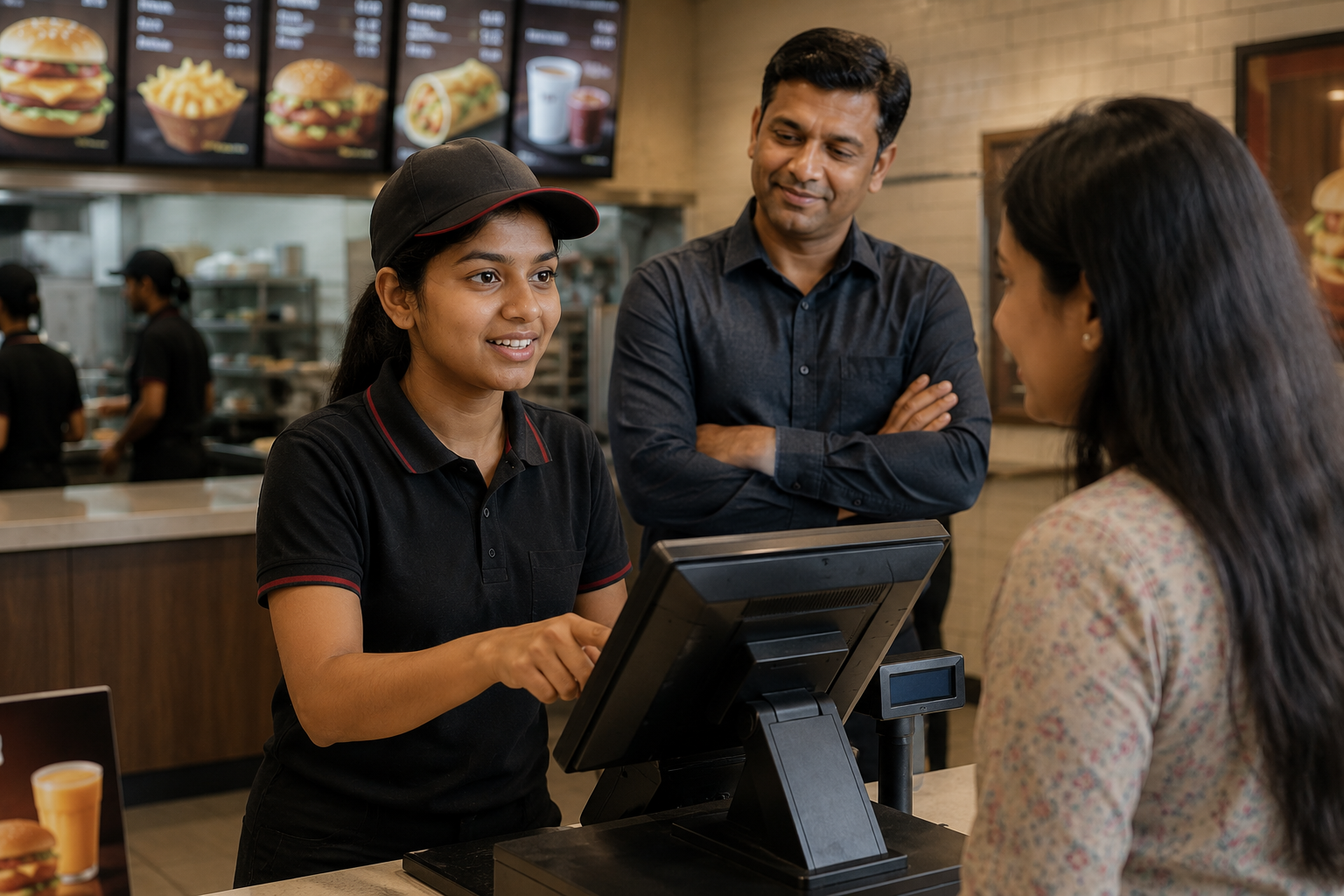
Think about what has to happen for a single brand standard to actually reach an employee at any given outlet. Whether it's a smaller franchise location in a hill town or a large franchise outlet in a busy metro city, it's the same brand, the same agreement, and the same training material. The standard doesn't travel there on its own.
The brand standard passes through a franchisee who interprets it, a manager who trains a new hire on it, and finally a shift where that new hire applies it under whatever conditions the day happens to bring. Each of these is a handoff, and each handoff is a place where the standard can bend a little. Not out of carelessness, but simply because nobody along the way is checking it against the original definition.
By the time it reaches the counter, "the same standard" may already be a few small interpretations removed from what HQ actually specified. This is the real problem a franchise brand is solving for. Not whether franchisees care about quality, most do. It's how one standard, defined once, shows up the same way at every outlet it's supposed to reach.
In a company-owned chain, a manager who drifts from the standard is still part of the same reporting line, and correcting that is a conversation within the business. A franchise brand has to stay just as involved in protecting the standard, but it does so from a distance: through the franchise agreement, the training it provides, and the checks it runs, rather than direct, day-to-day management of the store. That distance is exactly why a reliable way to verify the standard matters more here, not less.
A few recognizable patterns emerge from this:
None of this is in bad faith. It's just what happens when a standard is written down once centrally, but reaches each outlet through a different chain of people.
The fix isn't a longer training manual or a stricter franchise agreement. Those define the standard; they don't verify it reached the counter intact. What closes the gap is checking the standard at the point it's actually delivered, not as a general impression of the store, but as specific, verifiable details a customer would actually notice.
That means defining criteria at the line-item level, not the store level, with photo evidence required for each one:
A single photo of a storefront can't confirm any of these individually. For franchise brands, this is what makes store compliance measurable: each part of the standard can be checked against the same defined criteria, at every location.
Requiring a photo for every line item, at every outlet, on every audit cycle, solves the evidence problem. But it creates a new one: someone still has to look at all those photos. A handful of line items per outlet, multiplied across hundreds of locations, adds up fast. Weekly store audits across a few hundred locations can easily mean thousands of photos to review, every single cycle.
Doing that by hand means one of two things happens. Either you keep hiring reviewers as your store count grows, or the backlog quietly piles up and the standard slips along with it. In practice, teams often end up somewhere in the second camp, not because anyone stops caring, but because a few hundred stores' worth of photos is simply too much for a small team to get through carefully, week after week.
It also reintroduces the exact issue the checklist was meant to solve. The checklist was designed to remove interpretation from the outlet floor. It reintroduces it at the review desk instead: a tired reviewer on image four hundred applies less scrutiny than they did on image ten, and two reviewers looking at the same borderline photo can land on different calls.
This is the part AI image evaluation can solve for: not more evidence, but the ability to actually review the evidence being collected, at the volume franchise operations generate it. The workflow is a fixed sequence: criteria are defined once per line item, a photo is submitted from the outlet, Frontlyne's AI evaluates it against that specific criterion, the evaluation result and any required feedback are returned, a correction is made if needed, the photo is resubmitted, and the result sits in the audit record.
That loop applies consistently, evaluating each submission against the same defined criteria rather than a reviewer's individual read on any given day, across every outlet regardless of region or distance from head office. Because evaluation happens as photos come in, it creates a same-day correction loop: a franchisee's team can see where something doesn't meet the standard, correct it, and confirm compliance before the shift ends, rather than finding out at the next scheduled review.
A franchise standard only protects the customer when the brand can verify that standard at the point of execution. Digital audits, backed by AI image evaluation, turn the standard from something documented at HQ into something measurable at every location, wherever it sits.


A franchise brand's real promise to a customer is access: the same experience, at any location, regardless of who owns that particular store. That promise runs into a structural problem most other multi-location businesses don't have. The brand defines the standard, but each location is operated independently by a franchisee with their own staff, their own routines, and their own interpretation of how closely to follow what HQ specified.
We've written before about why proof matters more than trust in multi-location audits, and that argument holds here too. This piece looks at something more specific to franchise operations, and to franchise compliance in particular: the actual distance between a brand's standard and the person executing it, and what it takes to close that distance when the people executing it aren't necessarily your employees.
Think about what has to happen for a single brand standard to actually reach an employee at any given outlet. Whether it's a smaller franchise location in a hill town or a large franchise outlet in a busy metro city, it's the same brand, the same agreement, and the same training material. The standard doesn't travel there on its own.
The brand standard passes through a franchisee who interprets it, a manager who trains a new hire on it, and finally a shift where that new hire applies it under whatever conditions the day happens to bring. Each of these is a handoff, and each handoff is a place where the standard can bend a little. Not out of carelessness, but simply because nobody along the way is checking it against the original definition.
By the time it reaches the counter, "the same standard" may already be a few small interpretations removed from what HQ actually specified. This is the real problem a franchise brand is solving for. Not whether franchisees care about quality, most do. It's how one standard, defined once, shows up the same way at every outlet it's supposed to reach.
In a company-owned chain, a manager who drifts from the standard is still part of the same reporting line, and correcting that is a conversation within the business. A franchise brand has to stay just as involved in protecting the standard, but it does so from a distance: through the franchise agreement, the training it provides, and the checks it runs, rather than direct, day-to-day management of the store. That distance is exactly why a reliable way to verify the standard matters more here, not less.
A few recognizable patterns emerge from this:
None of this is in bad faith. It's just what happens when a standard is written down once centrally, but reaches each outlet through a different chain of people.
The fix isn't a longer training manual or a stricter franchise agreement. Those define the standard; they don't verify it reached the counter intact. What closes the gap is checking the standard at the point it's actually delivered, not as a general impression of the store, but as specific, verifiable details a customer would actually notice.
That means defining criteria at the line-item level, not the store level, with photo evidence required for each one:
A single photo of a storefront can't confirm any of these individually. For franchise brands, this is what makes store compliance measurable: each part of the standard can be checked against the same defined criteria, at every location.
Requiring a photo for every line item, at every outlet, on every audit cycle, solves the evidence problem. But it creates a new one: someone still has to look at all those photos. A handful of line items per outlet, multiplied across hundreds of locations, adds up fast. Weekly store audits across a few hundred locations can easily mean thousands of photos to review, every single cycle.
Doing that by hand means one of two things happens. Either you keep hiring reviewers as your store count grows, or the backlog quietly piles up and the standard slips along with it. In practice, teams often end up somewhere in the second camp, not because anyone stops caring, but because a few hundred stores' worth of photos is simply too much for a small team to get through carefully, week after week.
It also reintroduces the exact issue the checklist was meant to solve. The checklist was designed to remove interpretation from the outlet floor. It reintroduces it at the review desk instead: a tired reviewer on image four hundred applies less scrutiny than they did on image ten, and two reviewers looking at the same borderline photo can land on different calls.
This is the part AI image evaluation can solve for: not more evidence, but the ability to actually review the evidence being collected, at the volume franchise operations generate it. The workflow is a fixed sequence: criteria are defined once per line item, a photo is submitted from the outlet, Frontlyne's AI evaluates it against that specific criterion, the evaluation result and any required feedback are returned, a correction is made if needed, the photo is resubmitted, and the result sits in the audit record.
That loop applies consistently, evaluating each submission against the same defined criteria rather than a reviewer's individual read on any given day, across every outlet regardless of region or distance from head office. Because evaluation happens as photos come in, it creates a same-day correction loop: a franchisee's team can see where something doesn't meet the standard, correct it, and confirm compliance before the shift ends, rather than finding out at the next scheduled review.
A franchise standard only protects the customer when the brand can verify that standard at the point of execution. Digital audits, backed by AI image evaluation, turn the standard from something documented at HQ into something measurable at every location, wherever it sits.
Join the brands building better frontline workforces. Live in 50 days. No IT complexity. Dedicated support from day one.


.png)
.png)



.jpg)
.png)