By
Sanjana Chavali
June 4, 2026
•
7
min read

Note on examples in this article: The scenarios and timelines in this article are illustrative examples based on common patterns in retail compliance management. They are not based on specific clients or actual cases. Results vary by implementation and organizational context.Consider this common scenario in multi-location retail. A regional manager at a typical 200-store retail chain faces a familiar challenge:
"I know compliance is a problem, but I don't know where or why. Audit reports come in slowly. By the time I see them, stores have already moved on."
This challenge is widespread across the industry. Compliance issues exist everywhere, but visibility is fragmented and slow.
Store A has a cleanliness violation. Store B has food safety issues. Store C has inventory procedure violations. Each store's audit happens on different days. Reports compile slowly. Action is delayed. Problems repeat at the next audit.
The gap between finding a problem and fixing it is costing you compliance effectiveness, staff confusion, and inconsistent customer experience across locations.
The fastest-improving retail chains have moved from slow, fragmented visibility to real-time, structured oversight. This changes what's possible.
Most retail chains conduct audits one of two ways:
Both approaches have the same core problem: Lag between finding a problem and addressing it.
In the meantime:
Real-time visibility isn't just "fast reporting." It's structured oversight where:
When an audit identifies a violation, the relevant people are notified immediately (same day or next day), not weeks later. Store managers see exactly what went wrong before they've already moved on to the next task.
Problems that need action are automatically routed to the right person:
No manual emails. No getting lost in someone's inbox. The system ensures the right person sees it.
After corrective action is supposed to happen, a follow-up confirms whether the problem is fixed:
Result: Problems actually get solved, not just reported.
In this scenario, a cleanliness violation is discovered at a store location. Here's how the two systems would handle it:
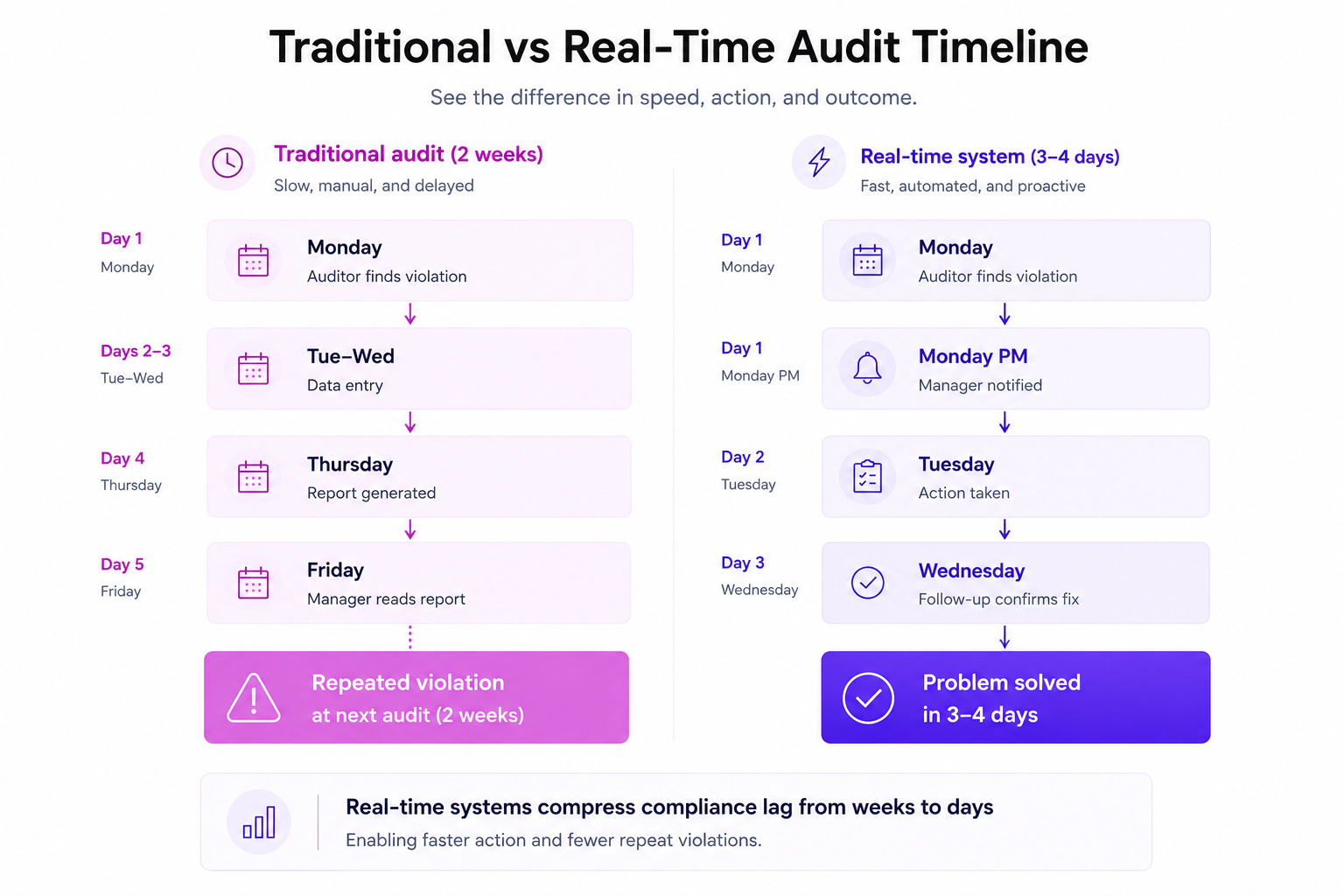
The difference: Real-time visibility creates immediate action and actual improvement.
Audits need to be consistent and objective, not subjective assessments.
Instead of: "Is the store clean? (Yes/No)"
Use: "Specific areas checked: Floor (debris present/not), Shelves (organized/not), Fitting rooms (neat/not), Stockroom (organized/not)"
Specific items prevent ambiguity and ensure every auditor is assessing the same things the same way.
When violations are found, capture evidence (photos, notes, context). This serves two purposes:
Store managers are notified of violations instantly (same day or next day), not weeks later. Quick notifications enable quick action. The longer the delay, the more context is lost and the harder it is for the manager to remember what led to the violation.
Store managers don't just guess how to fix problems. They have:
This eliminates confusion and ensures consistency across locations.
After time is given for correction, a follow-up audit validates whether the problem is actually fixed. Not assumed. Confirmed.
Here's the opportunity that real-time compliance data unlocks: You can see exactly which training drives measurable compliance improvement.
Consider this scenario from retail operations:
A store completes food safety training. The training completion rate is 95%. But here's the question training teams rarely get to answer: Did it actually improve food safety compliance?
With connected data, you can see:
The audit happens the following week. In areas where staff trained, food safety scores improved by 18 points. In areas without training, scores stayed the same. That tells you the training worked.
But what if the pattern was different? What if food safety violations reappeared in the same areas weeks after training? That tells you something else: The knowledge didn't stick. You need reinforcement, practice, or a different approach.
Or what if violations appeared in completely new areas that weren't addressed in training? That reveals a curriculum gap you didn't know existed.
With visibility into both training data AND audit data, you can answer powerful questions:
This is the power of connecting training and operations: You optimize training based on what actually moves the needle. No guessing. No hoping. Just data.
With real-time data across multiple locations, you can see patterns:
Patterns enable targeted action, not generic fixes.
Instead of generic support ("all stores need better training"), you allocate resources to what's actually needed:
This is more effective and more cost-efficient than blanket training.
Store managers with real-time compliance visibility know:
Transparency drives accountability.
This is the piece many organizations miss: Real-time compliance data creates a feedback loop between your training team and operations team.
Here's what typically happens without visibility:
Training team completes training → no visibility into whether it worked
Operations team sees violations → doesn't know if training happened or if staff just aren't complying
Each team blames the other. No one knows the real issue.
With real-time visibility, both teams can see:
This creates a feedback loop:
Without visibility between teams, this feedback loop doesn't exist. With it, compliance continuously improves.
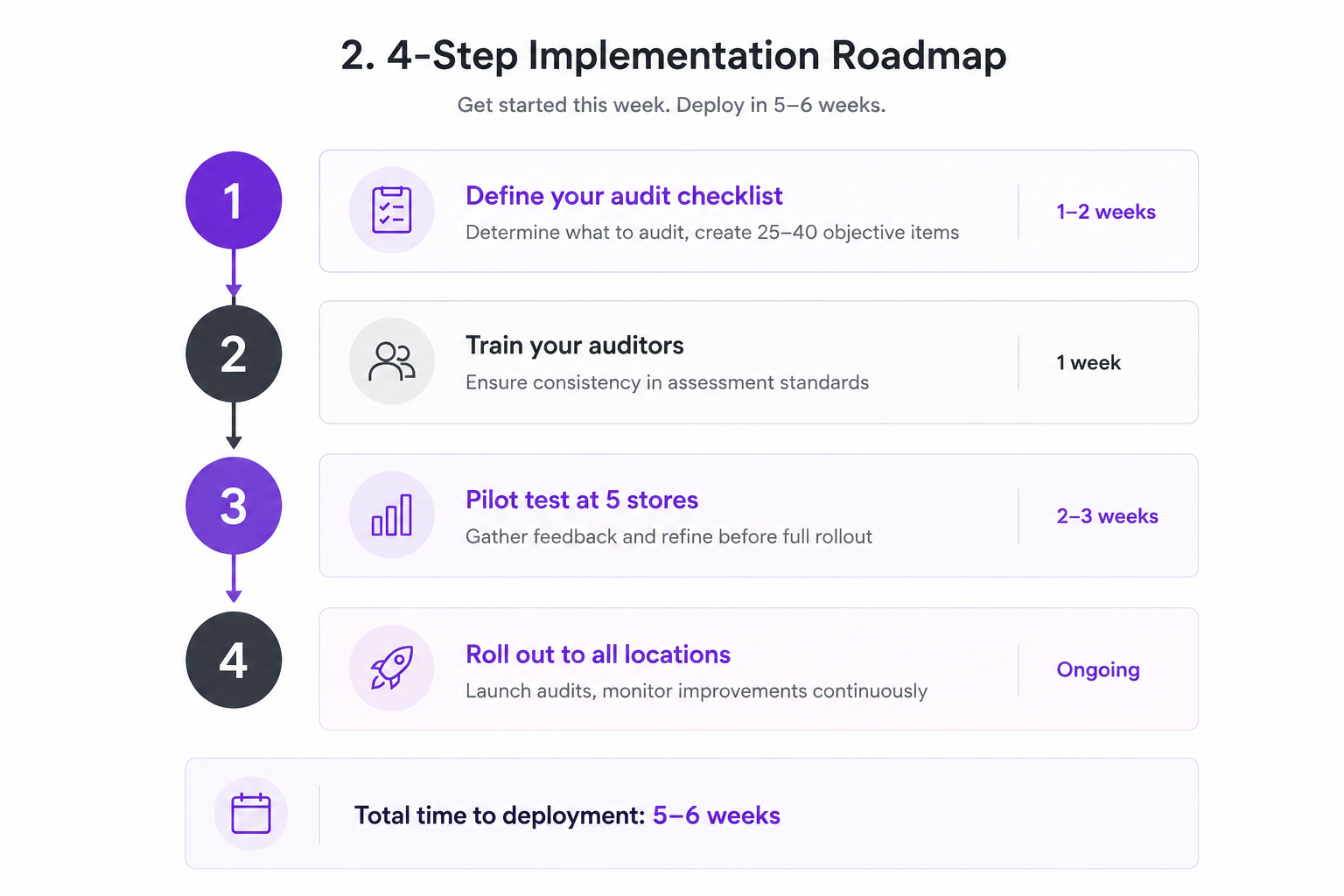
What are you auditing? Store cleanliness, SOP compliance, food safety, customer service, brand standards?
Create a specific checklist:
Make sure every auditor is assessing the same things the same way. Consistency matters more than comprehensiveness.
Auditors need to:
This ensures that whether an auditor is at Store 1 or Store 100, they're using the same standards.
Conduct audits at 5 test stores. Gather feedback:
Refine based on feedback. This prevents rolling out a system that doesn't work in practice.
Conduct regular audits (every 2-4 weeks, depending on your needs). Track:
This isn't a one-time project. It's an ongoing system that continuously improves your compliance posture.
Compliance doesn't stay stagnant. Real-time visibility and rapid response enable compliance to improve measurably over time.
Problems that are quickly identified and corrected don't repeat. Each audit shows fewer re-occurrences of previous violations.
Managers know exactly what problems exist, why they exist, and what needs to happen to fix them. No ambiguity. No guessing.
Instead of sending generic support ("all stores need training"), you send targeted support ("these 3 stores need help with X").
Training and operations work together toward the same goal. Both teams have visibility into what's working and what isn't. This creates a shared accountability for continuous improvement, where training knows if modules are effective, and operations knows which interventions actually drive compliance.
You now know:
Your next question: How long does it take from when you identify a compliance violation to when corrective action is completed? If it's more than 3-5 days, real-time visibility will accelerate improvement.


Note on examples in this article: The scenarios and timelines in this article are illustrative examples based on common patterns in retail compliance management. They are not based on specific clients or actual cases. Results vary by implementation and organizational context.Consider this common scenario in multi-location retail. A regional manager at a typical 200-store retail chain faces a familiar challenge:
"I know compliance is a problem, but I don't know where or why. Audit reports come in slowly. By the time I see them, stores have already moved on."
This challenge is widespread across the industry. Compliance issues exist everywhere, but visibility is fragmented and slow.
Store A has a cleanliness violation. Store B has food safety issues. Store C has inventory procedure violations. Each store's audit happens on different days. Reports compile slowly. Action is delayed. Problems repeat at the next audit.
The gap between finding a problem and fixing it is costing you compliance effectiveness, staff confusion, and inconsistent customer experience across locations.
The fastest-improving retail chains have moved from slow, fragmented visibility to real-time, structured oversight. This changes what's possible.
Most retail chains conduct audits one of two ways:
Both approaches have the same core problem: Lag between finding a problem and addressing it.
In the meantime:
Real-time visibility isn't just "fast reporting." It's structured oversight where:
When an audit identifies a violation, the relevant people are notified immediately (same day or next day), not weeks later. Store managers see exactly what went wrong before they've already moved on to the next task.
Problems that need action are automatically routed to the right person:
No manual emails. No getting lost in someone's inbox. The system ensures the right person sees it.
After corrective action is supposed to happen, a follow-up confirms whether the problem is fixed:
Result: Problems actually get solved, not just reported.
In this scenario, a cleanliness violation is discovered at a store location. Here's how the two systems would handle it:
The difference: Real-time visibility creates immediate action and actual improvement.
Audits need to be consistent and objective, not subjective assessments.
Instead of: "Is the store clean? (Yes/No)"
Use: "Specific areas checked: Floor (debris present/not), Shelves (organized/not), Fitting rooms (neat/not), Stockroom (organized/not)"
Specific items prevent ambiguity and ensure every auditor is assessing the same things the same way.
When violations are found, capture evidence (photos, notes, context). This serves two purposes:
Store managers are notified of violations instantly (same day or next day), not weeks later. Quick notifications enable quick action. The longer the delay, the more context is lost and the harder it is for the manager to remember what led to the violation.
Store managers don't just guess how to fix problems. They have:
This eliminates confusion and ensures consistency across locations.
After time is given for correction, a follow-up audit validates whether the problem is actually fixed. Not assumed. Confirmed.
Here's the opportunity that real-time compliance data unlocks: You can see exactly which training drives measurable compliance improvement.
Consider this scenario from retail operations:
A store completes food safety training. The training completion rate is 95%. But here's the question training teams rarely get to answer: Did it actually improve food safety compliance?
With connected data, you can see:
The audit happens the following week. In areas where staff trained, food safety scores improved by 18 points. In areas without training, scores stayed the same. That tells you the training worked.
But what if the pattern was different? What if food safety violations reappeared in the same areas weeks after training? That tells you something else: The knowledge didn't stick. You need reinforcement, practice, or a different approach.
Or what if violations appeared in completely new areas that weren't addressed in training? That reveals a curriculum gap you didn't know existed.
With visibility into both training data AND audit data, you can answer powerful questions:
This is the power of connecting training and operations: You optimize training based on what actually moves the needle. No guessing. No hoping. Just data.
With real-time data across multiple locations, you can see patterns:
Patterns enable targeted action, not generic fixes.
Instead of generic support ("all stores need better training"), you allocate resources to what's actually needed:
This is more effective and more cost-efficient than blanket training.
Store managers with real-time compliance visibility know:
Transparency drives accountability.
This is the piece many organizations miss: Real-time compliance data creates a feedback loop between your training team and operations team.
Here's what typically happens without visibility:
Training team completes training → no visibility into whether it worked
Operations team sees violations → doesn't know if training happened or if staff just aren't complying
Each team blames the other. No one knows the real issue.
With real-time visibility, both teams can see:
This creates a feedback loop:
Without visibility between teams, this feedback loop doesn't exist. With it, compliance continuously improves.
What are you auditing? Store cleanliness, SOP compliance, food safety, customer service, brand standards?
Create a specific checklist:
Make sure every auditor is assessing the same things the same way. Consistency matters more than comprehensiveness.
Auditors need to:
This ensures that whether an auditor is at Store 1 or Store 100, they're using the same standards.
Conduct audits at 5 test stores. Gather feedback:
Refine based on feedback. This prevents rolling out a system that doesn't work in practice.
Conduct regular audits (every 2-4 weeks, depending on your needs). Track:
This isn't a one-time project. It's an ongoing system that continuously improves your compliance posture.
Compliance doesn't stay stagnant. Real-time visibility and rapid response enable compliance to improve measurably over time.
Problems that are quickly identified and corrected don't repeat. Each audit shows fewer re-occurrences of previous violations.
Managers know exactly what problems exist, why they exist, and what needs to happen to fix them. No ambiguity. No guessing.
Instead of sending generic support ("all stores need training"), you send targeted support ("these 3 stores need help with X").
Training and operations work together toward the same goal. Both teams have visibility into what's working and what isn't. This creates a shared accountability for continuous improvement, where training knows if modules are effective, and operations knows which interventions actually drive compliance.
You now know:
Your next question: How long does it take from when you identify a compliance violation to when corrective action is completed? If it's more than 3-5 days, real-time visibility will accelerate improvement.
Join the brands building better frontline workforces. Live in 50 days. No IT complexity. Dedicated support from day one.



.jpg)
.png)


.png)
.jpg)


.png)
.png)